


As a supplier of 100 Pin SCSI Cables, I've witnessed firsthand the critical role these cables play in various industries. The reliability of a 100 Pin SCSI Cable is not just a matter of convenience; it's a fundamental requirement for seamless data transfer and system operation. In this blog, I'll delve into the key factors that can affect the reliability of these cables, drawing on my experience in the field.
Cable Construction and Materials
The construction and materials used in a 100 Pin SCSI Cable are the building blocks of its reliability. High - quality conductors are essential. Copper is a popular choice due to its excellent electrical conductivity. The purity of the copper can significantly impact the cable's performance. Higher purity copper reduces resistance, which in turn minimizes signal loss and heat generation. For instance, oxygen - free copper (OFC) is often used in premium cables as it has a lower oxygen content, reducing the likelihood of oxidation and corrosion over time.
Insulation materials also play a crucial role. A good insulation material should have high dielectric strength to prevent electrical leakage between conductors. Polyvinyl chloride (PVC) is a common insulation material, but for more demanding applications, materials like fluorinated ethylene propylene (FEP) or polyethylene (PE) may be preferred. FEP offers better heat resistance and chemical stability, while PE has low dielectric constant, which helps in maintaining signal integrity.
The shielding of the cable is another vital aspect. A 100 Pin SCSI Cable is often exposed to electromagnetic interference (EMI) and radio - frequency interference (RFI). A well - designed shield can protect the cable from these external interferences. There are different types of shielding, such as foil shielding and braided shielding. Foil shielding provides a continuous layer of protection, while braided shielding offers better flexibility and mechanical protection. In some high - performance cables, a combination of both foil and braided shielding is used to provide comprehensive protection.
Connector Quality
The connectors at the ends of the 100 Pin SCSI Cable are just as important as the cable itself. A poor - quality connector can lead to intermittent connections, signal degradation, and even complete system failure. The pins in the connector should be made of high - quality metal, typically gold - plated. Gold plating provides excellent corrosion resistance and low contact resistance. It ensures a stable electrical connection between the cable and the device.
The mechanical design of the connector is also crucial. It should have a secure locking mechanism to prevent accidental disconnection. A loose connection can cause signal interruptions and data errors. Additionally, the connector should be able to withstand repeated insertions and removals without significant wear and tear. For example, connectors with a high - cycle rating are more suitable for applications where the cable needs to be frequently connected and disconnected.
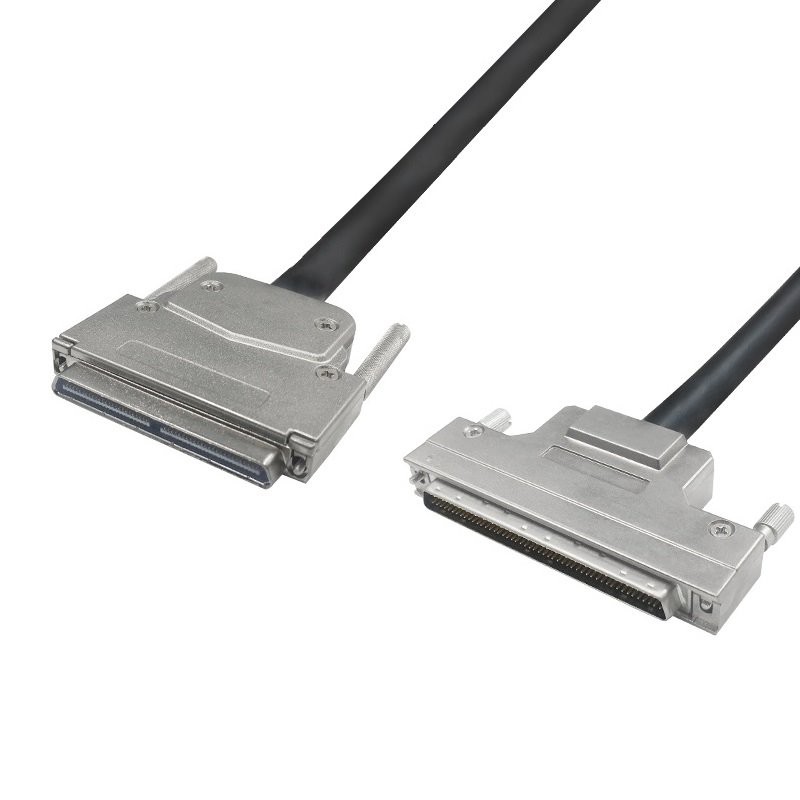
We offer a variety of high - quality connectors in our 100 Pin SCSI Cable products. For example, our 0.80mm pitch HDRA 100 pin to HPDB 100 pin Motion Controller Adapter Cable features precision - engineered connectors that ensure reliable connections in motion control applications.

Cable Length
The length of a 100 Pin SCSI Cable can have a significant impact on its reliability. As the length of the cable increases, the resistance of the conductors also increases. This leads to greater signal attenuation, which means that the strength of the signal decreases as it travels along the cable. Signal attenuation can cause data errors, especially in high - speed data transfer applications.
In addition to signal attenuation, longer cables are more susceptible to EMI and RFI. The longer the cable, the more surface area it has exposed to external electromagnetic fields, increasing the likelihood of interference. Therefore, it's important to choose the appropriate cable length for your application. If a longer cable is required, additional signal amplification or equalization may be necessary to maintain signal integrity.
Environmental Conditions
The environment in which the 100 Pin SCSI Cable operates can greatly affect its reliability. Temperature is a major factor. Extreme temperatures can cause the materials in the cable to expand or contract, which may lead to mechanical stress on the conductors and insulation. High temperatures can also accelerate the aging process of the insulation and increase the risk of oxidation. For example, in industrial environments where the temperature can be very high, cables with heat - resistant materials are required.
Humidity is another environmental factor. Moisture can penetrate the cable and cause corrosion of the conductors and connectors. In high - humidity environments, cables with proper sealing and moisture - resistant materials should be used. Chemical exposure is also a concern. In some industrial settings, cables may be exposed to chemicals such as solvents, acids, or alkalis. These chemicals can damage the insulation and conductors, reducing the cable's reliability.
Installation and Handling
Proper installation and handling of the 100 Pin SCSI Cable are essential for its long - term reliability. During installation, the cable should be routed carefully to avoid sharp bends and kinks. Sharp bends can cause the conductors to break or the insulation to crack, leading to signal problems. The cable should also be secured properly to prevent it from moving or vibrating, which can cause mechanical stress on the connectors and the cable itself.
When handling the cable, it's important to avoid pulling or stretching it excessively. Excessive pulling can damage the internal conductors and insulation. Also, the connectors should be handled with care to prevent bending or breaking of the pins.
Cable Flexibility and Bending Radius
Flexibility is an important consideration, especially in applications where the cable needs to be moved or bent frequently. A cable with good flexibility can withstand repeated bending without damage. The bending radius of the cable is a key parameter. It refers to the minimum radius that the cable can be bent without causing permanent damage. A smaller bending radius allows for more compact installations, but the cable must be designed to handle such tight bends.
If the cable is bent beyond its specified bending radius, the internal conductors may break, and the insulation may crack. This can lead to signal loss and reduced reliability. Our 100 Pin Male to Male SCSI Cable is designed with an appropriate bending radius to ensure flexibility and reliability in various applications.
Signal Integrity and Data Rate
In modern applications, high - speed data transfer is becoming increasingly common. The 100 Pin SCSI Cable must be able to support the required data rate without significant signal degradation. As the data rate increases, the cable's ability to maintain signal integrity becomes more critical. Higher data rates require better - quality cables with lower attenuation and crosstalk.
Crosstalk is the interference between adjacent conductors in the cable. It can cause data errors and reduce the overall reliability of the cable. To minimize crosstalk, the cable should be designed with proper conductor spacing and shielding. Our 0.80mm picth HDRA 100 Pin To VHDCI 100 Pin Servo SCSI Cable is engineered to support high - speed data transfer with minimal crosstalk, ensuring reliable performance in servo control applications.
Conclusion
The reliability of a 100 Pin SCSI Cable is influenced by a multitude of factors, including cable construction and materials, connector quality, cable length, environmental conditions, installation and handling, flexibility, and signal integrity. As a supplier, we understand the importance of these factors and strive to provide high - quality cables that meet the diverse needs of our customers.
If you are in the market for a reliable 100 Pin SCSI Cable, we invite you to contact us for more information and to discuss your specific requirements. Our team of experts is ready to assist you in selecting the right cable for your application.
References
- Groth, R. (2019). High - Speed Signal Propagation: Advanced Black Magic. Prentice Hall.
- Montrose, M. I. (2011). Printed Circuit Board Design Techniques for EMC Compliance: A Handbook for Designers. Wiley - IEEE Press.