



Network Patch Cable
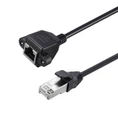
Networking patch cables (also known as Ethernet patch cords or network jumper cables) is pre-terminated short network wires with crimped 8P8C RJ45 connectors on both ends. Different with solid bulk in-wall cables for fixed building wiring, standard network patch cords adopt twisted copper conductors for great flexibility. Support frequent plugging, repeated bending and daily wiring changes. Mainly applied to point-to-point short connections among switches, routers, PCs, servers and network wall jack modules.


Core features than ordinary bulk Ethernet cables
Stranded copper
Multiple copper cores strands twisted together, featuring high flexibility and bending resistance
Short length
Common lengths from 0.15m to 10m, dedicated for device interconnection instead of long-distance in-wall laying
less Time
No on-site crimping required, easy to install, replace and maintain
Main Classification of Ethernet network cable:
Networking patch cables have a full classification system per TIA/EIA 568 cabling wiring & ISO/IEC 11801 cabling standards. Commonly categorized by transmission grade, EMI shielding structure, wire form and jacket material, offering Ethernet patch cords for all kinds of network applications.

2.1 Classification By Performance Category (Cat Series)
Classified by Cat performance grades it specifies different types LAN patch cable with bandwidth, maximum transmission speed and effective transmission distance. You can serves it as the main reference for users to select suitable patch cords.
| Item | Maximum Speed | Bandwidth | Maximum Length | Shielding | Typical Usage |
|---|---|---|---|---|---|
| Cat5e Patch Cable | 1 Gbps | 100 MHz | 100 m | UTP, FTP or sstp is supported | ordinary home and office environments |
| Cat6 Patch Cable | 10 Gbps (37–55 m) | 250 MHz | 100 m (55 m for 10GBASE-T) | UTP or STP | Home, Gigabit, short 10G |
| Cat6A Patch Cable | 10 Gbps (100 m) | 500 MHz | 100m | Typically STP | Data centers, 10G at full distance |
| Cat7 Patch Cable | 10 Gbps (100 m) | 600 MHz | 100 m | Fully shielded (SSTP/SFTP) | High-interference environments, 10G networks |
| Cat8 Patch Cable | 40 Gbps | 2000 MHz | 30m | Fully shielded (SSTP/SFTP) | Short-distance data center connections (up to 30m) |
2.2 Classification By Shielding Structure
Shielding structure of RJ45 networking cables determines its anti-electromagnetic interference capability, which is a key factor when selecting Ethernet patch cords for different wiring environments.

UTP (Unshielded)
unshielded computer RJ45 networking patch cable has no metal shielding layer. Offers good flexibility, low cost and easy installation, ideal for regular home and office environments without strong electromagnetic interference.

FTP (Foil Twisted Pair):
FTP RJ45 Ethernet patch cable applies overall aluminum foil shielding for all wire pairs to effectively resist external electromagnetic interference, suitable for general offices and low-interference computer rooms.

S/FTP (SFTP, individual pair foil + overall shield):
SFTP RJ45 networking cables adopts double shielding structure with individual aluminum foil shielding for each wire pair plus outer overall shielding, delivering premium anti-interference performance. S/FTP structure is required for high-end Cat7 and Cat8 patch cables.
2.3 Classification by wiring standard

• T568B: Mainstream for domestic & overseas sales. Used for more than 95% of patch cords.
• T568A: Old North American cabling standard, seldom used now.
Note: Modern network hardware supports Auto-MDI-X automatic crossover. Traditional crossover cables are mostly obsolete; no separate selection needed.
2.4 Other Common Classifications
By cable shape: Round high speed network patch cable offer stable standard transmission performance; flat Ethernet patch cords are ultra-thin, perfect for gap wiring and desktop wiring beautification.
By sheath material: PVC sheath Gigabit Ethernet patch cable are durable for daily use; LSZH (low smoke zero halogen) patch cables are flame-retardant and eco-friendly, suitable for public buildings and professional machine rooms.
By wire core: Stranded core is the standard for all qualified RJ45 to RJ45 Ethernet cable, featuring bend resistance for frequent plugging; solid core cables are only for fixed in-wall wiring and not applicable as RJ45 LAN patch cable.
Pros and Cons of Different Patch Cables
Cat5e Networking Patch Cable
Pros: Cat5e networking Patch cables are cost-effective with broad compatibility, soft jacket with good durability, ideal for daily gigabit networking in homes and offices.
Cons: Cat5e UTP snagless network patch cable is not capable of 10G networking. Its weak high-frequency anti-crosstalk performance fails ultra-high speed transmission needs.
Cat6 Networking Patch Cable
Pros: Cat6 networking cables feature great cost-performance, stable gigabit connectivity, short-range 10G burst transmission and dependable crosstalk reduction.
Cons: Cat6 SFTP shielded ethernet patch cord cannot maintain 10G speed over 100-meter distance. Low-grade versions without cross isolation skeletons will suffer severe performance degradation.
Cat6A Networking Patch Cable
Pros: Cat6A networking cables support steady full-length 10G transmission and low signal loss. Offered in UTP and shielded types, they deliver well-rounded high performance for residential & commercial high-speed networks.
Cons: Compared with Cat6 Ethernet patch cords, Cat6A Ethernet patch cords feature higher cost and larger outer diameter, which results in slightly greater wiring difficulty.
Cat7 Networking Patch Cable
Pros: Cat7 networking cables feature double shielding with industry-top EMI resistance, supporting ultra-high bandwidth and short-range 40G high-speed data transmission.
Cons: premium Cat7 double shielded industrial patch cable is costly and stiff. Professional grounding installation is required during deployment. Its superior performance is redundant for regular home network use.
Pros: Cat8 networking cables deliver industry-leading 2GHz bandwidth and 40Gbps ultra-high transmission speed. With ultra-low latency, they can easily support heavy high-speed data transfer.
Cons: Professional Cat8 40Gbps data center patch cord is limited to 30m transmission. High cost and low flexibility make it ideal solely for short connections in data centers.

Shielded Networking Cable Comparison(UTP / FTP / S/FTP)
|
Advantages |
Disadvantages | Application | |
|---|---|---|---|
| UTP(Unshielded Twisted Pair) |
1.Low cost 2.Flexible and easy to install 3.No grounding required 4.Simple termination |
1.Poor anti-interference performance 2.Susceptible to EMI & RFI 3.Not suitable for heavy electromagnetic environment |
Home & general office, non-interference environments |
| FTP(Foiled Twisted Pair) |
1.Overall foil shielding against EMI/RFI 2.Better noise suppression than UTP 3.Relatively low cost among shielded cables 4.Easy cable routing |
1.Shield failure if grounding is poor 2.Less anti-crosstalk than S/FTP 3.Foil is vulnerable to damage during bending |
Light-interference computer rooms, general commercial low-voltage wiring |
| S/FTP(Screened Foiled Twisted Pair) |
1.Dual shielding: individual pair foil + overall braid 2.Excellent anti-EMI & anti-crosstalk performance 3.Stable high-speed transmission 4.Superior protection for high-frequency signal |
1.Higher material cost 2.Larger cable diameter, less flexible 3.Strict grounding requirement 4.More complex termination |
Heavy EMI industrial sites, professional server rooms, Cat7/Cat8 high-speed wiring |
Typical Applications of Networking Patch Cables
Home Network
Cat5e patch cords is suitable for routers, optical modems, PCs and smart devices. For 10G home NAS and gaming networks, Cat6 / Cat6A patch cords are recommended.
Office & Commercial Buildings
UTP Cat5e and UTP Cat6 patch cords are the mainstream choice for Mass connections between patch panels, network switches, workstations and printers.
Surveillance & Low-Voltage Projects
Signal transmission between IP cameras, NVRs and switches. Cat5e patch cords for standard-definition surveillance; high-bandwidth Cat6 patch cords for 4K HD surveillance.
Server Rooms & Small Data Centers
In-cabinet wiring and interconnections between switches and servers. Shielded Cat6A and Cat7 patch cords is ok.
Enterprise Data Centers
Short-range 40G high-speed links between top-of-rack switches and servers. Specialized Cat8 patch cords (within 30 meters) support ultra-high-speed data transmission.
Special Applications
Low-smoke zero-halogen flame-retardant network patch cords for malls, subways and hospitals. Slim flat patch cords for concealed desktop and gap wiring with better aesthetics.
How to choose suitable Networking Patch Cable

Determine your required bandwidth & speed
Cat5e: Supports up to 1Gbps gigabit network, ideal for home internet, standard IP cameras and office daily use.
Cat6: Up to 10Gbps within 55 meters, suitable for 4K surveillance, home NAS and gaming networks.
Cat6A: Delivers stable 10Gbps up to 100 meters; shielded variants work well in interference-prone environments.
Cat7: 10Gbps~40Gbps, fully shielded for strong anti-interference, widely used in server rooms.
Cat8: Up to 40Gbps at maximum 30 meters, designed for short-range high-speed links in professional data centers.
Pick shielded or unshielded type
Unshielded (UTP): Low cost, easy installation, perfect for home and ordinary office environments without electromagnetic interference.
Shielded (FTP/STP): Reduces signal interference. Choose shielded patch cords for factories, machine rooms or dense cabling areas.


Select jacket material for different scenarios
Standard PVC: Common indoor use, cost-effective.
LSZH (Low Smoke Zero Halogen): Flame-retardant, releases little toxic smoke when burning. Required for public spaces including hospitals, subways and shopping malls.
Slim flat cable: For concealed wiring, desk gaps and tight spaces for neat installation.
Confirm cable length and connector quality
Avoid excessively long cables to prevent signal attenuation. Gold-plated RJ45 connectors ensure stable contact and reduce packet loss.

Company profile
Starte is a professional factory focused on the R&D, manufacturing and sales of network patch cords. Product range covers Cat5e, Cat6, Cat6a, Cat7 and Cat8, including standard, shielded, flat, high-temperature resistant and industrial drag-chain networking Lan cables. Widely applied in data centers, system cabling, smart home, security and industrial automation, our products deliver stable and high-performance wiring solutions for global partners.
Starte offer personalized cable customization, OEM/ODM manufacturing and professional technical solutions. We support sample orders, small-batch trial production and large-scale mass production to satisfy diverse customer demands.

01
In-house Production & Stable Lead Time
Own full automatic production and testing lines with standardized dust-free workshops.
02
Strict Quality Control & International Standard
Follows ISO quality management system and complies with TIA/EIA and IEEE international standards
03
Complete Product Specifications
Provide full-speed network cables ranging from 100M to 40G, including UTP, FTP and SFTP types.
04
Customization & OEM/ODM Service
Offer cable customization, OEM/ODM manufacturing and professional technical solutions
Shenzhen Starte Technology Co., Ltd is one of the most professional network cable manufacturers and suppliers in China. Welcome to wholesale bulk high quality network cable made in China here from our factory. For customized service, contact our factory.