




Hey there! As a supplier of 100 Pin SCSI Cables, I often get asked about the characteristic impedance of these cables. So, let's dive right in and break it down.
First off, what's characteristic impedance? Well, in simple terms, characteristic impedance is the ratio of the voltage to the current of a wave traveling along a transmission line, like our 100 Pin SCSI Cable. It's a crucial electrical property that ensures proper signal transmission. When a signal travels down a cable, it needs a consistent impedance path. If there are impedance mismatches, signals can be reflected back, leading to signal degradation, interference, and even errors in data transmission.
For 100 Pin SCSI Cables, the typical characteristic impedance is around 90 - 100 ohms. This value is carefully designed and engineered to match the impedance of the devices that the cables are connected to. SCSI (Small Computer System Interface) devices, including hard drives, CD - ROM drives, and printers that use 100 - pin interfaces, are designed to work with cables having this specific range of characteristic impedance.
Let me give you an example to make it clearer. Imagine you're trying to pour water through a hose. If the hose has a consistent diameter all the way through, the water will flow smoothly. But if there are sudden changes in the hose's diameter, the water will start to back up and cause turbulence. Similarly, in a 100 Pin SCSI Cable, a consistent characteristic impedance ensures that the electrical signals flow smoothly from one device to another.
Now, how is this characteristic impedance achieved in our cables? It all boils down to the cable's physical construction. The choice of conductor materials, the spacing between the conductors, and the insulation used around the conductors all play a role.
We use high - quality copper conductors in our 100 Pin SCSI Cables. Copper is an excellent conductor of electricity, and it helps in maintaining a stable impedance. The size of the copper conductors is carefully selected to match the required impedance. If the conductors are too thin, the impedance will be higher, and if they are too thick, the impedance will be lower.
The spacing between the conductors is also critical. Each conductor in the cable has a specific distance from its neighboring conductors. This spacing helps in controlling the capacitance and inductance between the conductors, which in turn affects the characteristic impedance. The insulation material around the conductors also has an impact. It provides electrical isolation between the conductors and influences the overall electrical properties of the cable.
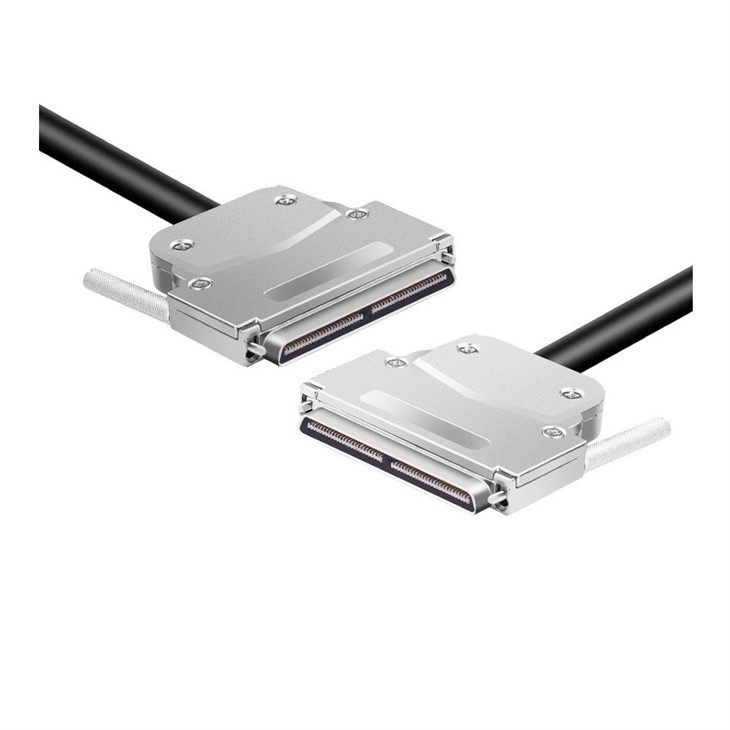
As a 100 Pin SCSI Cable supplier, we offer a wide range of products. For instance, we have the High Density 100 Pin SCSI Cable Assembly. This cable is designed for applications where space is limited, but you still need high - performance data transmission. It maintains the proper characteristic impedance, ensuring reliable signal transfer.
Another popular product in our lineup is the MDR100 Pin To HPCN 100 Pin SCSI Cable. This cable is great for connecting different types of SCSI devices with these specific pin configurations. We've engineered it to have the right characteristic impedance so that you don't have to worry about signal disruptions.
And then there's the 0.80mm picth HDRA 100 Pin To VHDCI 100 Pin Servo SCSI Cable. This cable is often used in servo - controlled systems, where precise signal transmission is essential. The characteristic impedance is carefully maintained to ensure accurate control and data transfer.
When it comes to testing the characteristic impedance of our 100 Pin SCSI Cables, we use advanced testing equipment. We measure the impedance along the entire length of the cable to make sure it stays within the specified range. This rigorous testing process guarantees that every cable we supply meets the highest quality standards.
In real - world applications, having the correct characteristic impedance in a 100 Pin SCSI Cable can make a huge difference. In a data center, for example, where multiple SCSI - connected devices are sharing data at high speeds, a cable with the wrong impedance can lead to data loss and system downtime. By using our cables with the proper characteristic impedance, you can ensure smooth and reliable operation of your SCSI - based systems.
If you're in the market for 100 Pin SCSI Cables, you should definitely consider the characteristic impedance. It's not something to overlook. A cable with the right impedance will save you a lot of headaches in terms of signal quality and system reliability.
We're here to help you find the perfect 100 Pin SCSI Cable for your needs. Whether you're a small business looking to upgrade your storage system or a large enterprise managing a complex network of SCSI devices, we've got you covered. We're always happy to discuss your requirements and offer the best solutions. If you're interested in purchasing our cables, don't hesitate to reach out for a procurement discussion. We'll work with you to ensure you get the right cables at the best prices.

References
- "High - Speed Digital Design: A Handbook of Black Magic" by Howard Johnson and Martin Graham.
- "The Art of Electronics" by Paul Horowitz and Winfield Hill.