


Hey there! As a supplier of parallel cables, I get asked a lot about the error rate of these cables. It's a super important topic, especially for those who rely on parallel cables for their day - to - day operations. So, let's dive right in and explore what the error rate of a parallel cable is all about.
First off, what exactly is a parallel cable? Well, it's a type of cable that can transmit multiple data bits simultaneously. Unlike serial cables, which send data one bit at a time, parallel cables are designed to boost data transfer speeds. They're commonly used for connecting printers, scanners, and other peripherals to computers. You can check out some of our great parallel cables like the DB25 To Centronics 36 Parallel Printer Cable or the DB25 Male to Centronics 36 Male Parallel Printer Cable.
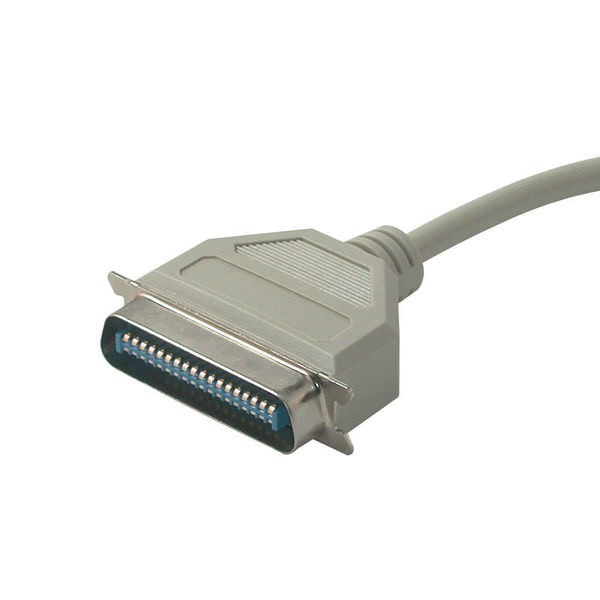

Now, onto the error rate. The error rate of a parallel cable refers to the frequency at which data transmitted through the cable is corrupted or lost. It's usually expressed as a ratio, like the number of errors per a certain number of transmitted bits. For example, an error rate of 1 in 1,000,000 means that, on average, one bit out of every million transmitted bits will be incorrect.
There are several factors that can influence the error rate of a parallel cable. One of the main culprits is electromagnetic interference (EMI). EMI can come from a bunch of sources, such as power lines, motors, and even other electronic devices. When a parallel cable is exposed to EMI, the electrical signals carrying the data can get disrupted, leading to errors.
The length of the cable also plays a big role. Longer cables are more prone to signal degradation. As the electrical signals travel through the cable, they lose strength, and this can cause the data to become distorted. So, if you're using a really long parallel cable, you might notice a higher error rate.
Another factor is the quality of the cable itself. High - quality cables are made with better materials and have better shielding to protect against EMI. Cheaper cables might not have the same level of protection, which can result in a higher error rate. For instance, our 34 Pin V.35 Male To Female Rounter Data Cable is made with top - notch materials to minimize the error rate.
Let's talk about how to measure the error rate. There are a few ways to do this. One common method is to use a protocol analyzer. This device can monitor the data being transmitted through the cable and detect any errors. It can then calculate the error rate based on the number of errors detected over a given period of time.
Another way is to use error - correcting codes. These are special algorithms that are built into the data transmission system. When data is sent, the error - correcting code adds some extra information to the data. At the receiving end, the code checks the data and can correct some of the errors. By analyzing how often the error - correcting code has to make corrections, you can get an idea of the error rate.
So, what's an acceptable error rate? Well, it really depends on the application. For some less critical applications, like printing a document, a relatively high error rate might be okay. But for applications that require high - precision data transfer, like in scientific research or financial transactions, a very low error rate is essential.
As a supplier, we understand the importance of keeping the error rate low. That's why we put a lot of effort into testing our parallel cables. We use state - of - the - art equipment to simulate different operating conditions and make sure that our cables meet strict quality standards.
We also offer a wide range of cables to suit different needs. Whether you need a short cable for a small office setup or a long cable for a large - scale industrial application, we've got you covered. And if you're not sure which cable is right for you, our team of experts is always here to help.
If you're in the market for parallel cables and want to ensure a low error rate, you should definitely consider working with us. We've got the experience and the products to provide you with reliable and high - performance cables.
Contact us to start a discussion about your specific requirements. We're eager to understand your needs and find the perfect parallel cable solution for you. Whether it's about the error rate, cable length, or any other aspect, we'll work closely with you to make sure you get exactly what you're looking for.
References
- "Data Communications and Networking" by Behrouz A. Forouzan
- "Electromagnetic Compatibility Engineering" by Henry W. Ott