


Hey there! As a serial cable supplier, I often get asked about the shock resistance of serial cables. It's a crucial aspect, especially when these cables are used in various environments where they might be exposed to physical impacts or vibrations. So, let's dive right in and explore what shock resistance means for serial cables.
First off, what exactly is shock resistance? In simple terms, it's the ability of a serial cable to withstand sudden impacts or jolts without suffering damage to its internal components or losing its functionality. When a cable has good shock resistance, it can continue to transmit data accurately even when it's been knocked around a bit.
There are several factors that contribute to the shock resistance of a serial cable. One of the most important is the construction of the cable itself. A well - built cable will have a sturdy outer jacket that can absorb some of the impact energy. For example, cables with a thick, rubberized outer layer are generally more shock - resistant than those with a thin, plastic covering.
The internal wiring also plays a big role. High - quality conductors that are properly insulated and bundled together can better withstand the forces generated by a shock. If the wires are loose or poorly insulated, they're more likely to break or short - circuit when the cable is subjected to a sudden impact.
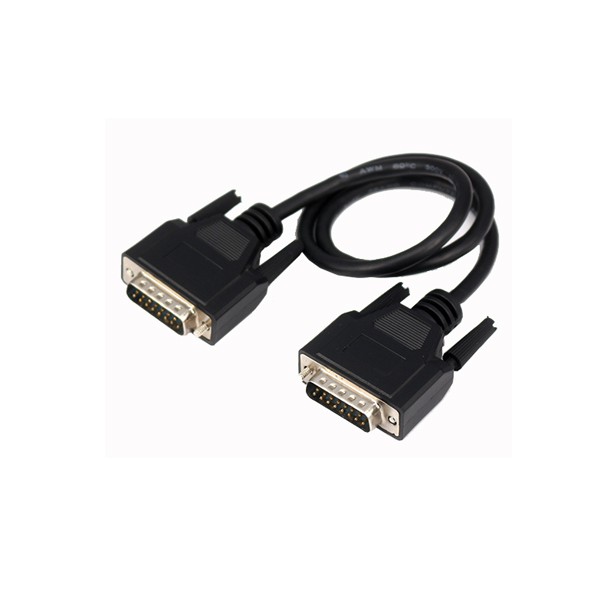
Another factor is the connectors. The connectors at the ends of the serial cable need to be firmly attached and well - designed. Loose connectors can come loose during a shock, causing a loss of connection. Connectors with a locking mechanism, like the ones on some DB15 Male to Male Serial Cable, are generally more reliable in high - shock environments.
Now, let's talk about why shock resistance matters. In industrial settings, serial cables are often used in machinery that can vibrate or move around. For instance, in manufacturing plants, robots and conveyor systems use serial cables to communicate. If these cables aren't shock - resistant, they can break easily, leading to costly downtime and repairs.
In the automotive industry, serial cables are used in vehicles for various functions, such as connecting sensors and control units. The constant vibrations and bumps on the road can put a lot of stress on these cables. A shock - resistant cable ensures that the vehicle's systems operate smoothly and safely.
In the field of telecommunications, serial cables are used to connect networking equipment. Any interruption in the data transmission due to a cable failure can cause significant problems, such as dropped calls or slow internet speeds. Shock - resistant cables help maintain a stable connection in these environments.
Let's take a look at some of the products we offer and how their shock resistance is designed. Our D - sub 25 Position Male Open End Tinned Cable is built with a tough outer jacket that provides good protection against impacts. The tinned conductors inside are more resistant to corrosion and can better handle the stress from shocks.
The Transparent 9 - Connductor RS232 Shielded Modem Cable is another great example. Its shielding not only protects against electromagnetic interference but also adds some structural integrity to the cable, enhancing its shock resistance. The 9 - conductor design ensures that the data transmission is stable even when the cable is jostled.
When it comes to testing the shock resistance of our serial cables, we follow strict industry standards. We subject our cables to a series of impact tests using specialized equipment. These tests simulate real - world scenarios, such as a cable being dropped or hit by a tool. Only cables that pass these tests are approved for sale.
But it's not just about passing the tests. We also take into account user feedback and real - world performance. If a customer reports an issue with a cable's shock resistance, we investigate it thoroughly and make any necessary improvements to our manufacturing process.
If you're in the market for serial cables, shock resistance should definitely be on your list of considerations. Whether you're using them in an industrial, automotive, or telecommunications setting, a shock - resistant cable can save you a lot of headaches in the long run.
We understand that every customer has different needs when it comes to serial cables. That's why we offer a wide range of products with varying levels of shock resistance. If you have specific requirements, such as a cable that needs to withstand extremely high impacts, we can work with you to find the right solution.
If you're interested in learning more about our shock - resistant serial cables or want to discuss your specific needs, we'd love to hear from you. Contact us for a detailed consultation and let's start a conversation about how we can meet your cable requirements.
References

- Industry standards for cable shock resistance testing
- Internal research and development reports on cable construction and shock resistance