


Yo, folks! As a serial adapter supplier, I often get asked some pretty interesting questions. One that's been popping up a lot lately is, "Can a serial adapter be used for underwater communication?" Well, let's dive right into it and see what's up.
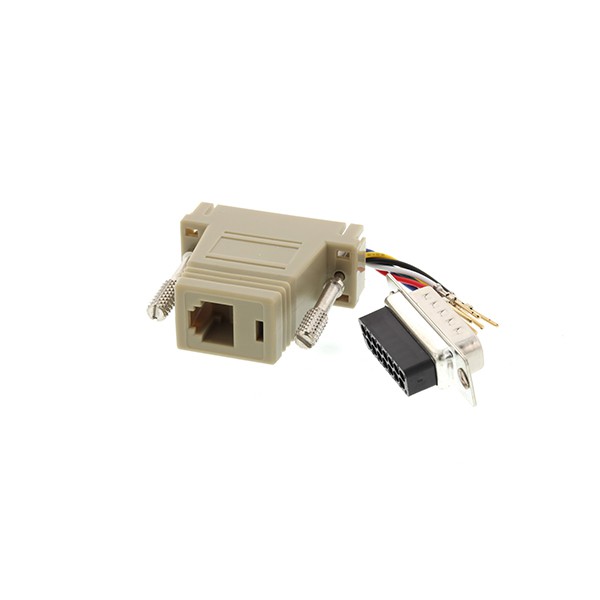
First off, let's talk about what a serial adapter is. For those who aren't in the know, it's a device that lets you connect different types of serial ports. We've got a bunch of different ones in our catalog, like the DB9 Female To Female Mini Gender Changer, the DB25 Female To DB25 Female Gender Changer, and the DB15 Male To RJ45 Computer Adaptor. These babies are great for all sorts of regular communication tasks, but can they handle the unique challenges of underwater environments?
The Challenges of Underwater Communication
Underwater communication is a whole different ballgame compared to regular land - based communication. Water is a much more challenging medium than air. It has high electrical conductivity, which can cause signal interference. Saltwater, in particular, is a great conductor of electricity, and it can mess up the electrical signals that serial adapters rely on.
Another big issue is attenuation. Signals tend to weaken a lot faster in water than in air. This means that the distance that a signal can travel underwater is severely limited. You might have a top - notch serial adapter that works great on land, but once you stick it underwater, the signal might not even make it a few meters before it fades away.

Pressure is also a major factor. As you go deeper underwater, the water pressure increases significantly. This can cause physical damage to electronic devices like serial adapters. The seals on the adapter might break, allowing water to seep in and fry the electronics inside. We're talking about some serious pressure here, like hundreds or even thousands of pounds per square inch in deep - sea environments.
Traditional Uses of Serial Adapters
On land, serial adapters are super useful. They're used in all sorts of industries, from IT to manufacturing. In the IT world, you might use a serial adapter to connect an old - school device that only has a serial port to a modern computer that doesn't have one. In manufacturing, they can be used to communicate between different machines on the factory floor.
But the conditions on land are a far cry from those underwater. On land, we don't have to worry about the high conductivity of water or the crushing pressure. The air is a much more forgiving medium for sending electrical signals.
Can Serial Adapters Be Modified for Underwater Use?
Now, the question is, can we tweak serial adapters to work underwater? Well, it's possible, but it's not going to be easy.
To deal with the conductivity issue, we'd need to come up with some serious shielding. The shielding would have to be able to block out the electrical interference caused by the water. This could involve using special conductive materials that can redirect the electrical currents away from the adapter's internal components.
For the attenuation problem, we'd need to boost the signal strength. This might mean adding some sort of amplifier to the adapter. But amplifiers also generate heat, and in an underwater environment, getting rid of that heat can be a real pain.
To handle the pressure, we'd have to design a water - tight and pressure - resistant casing for the adapter. This casing would need to be strong enough to withstand the pressure at the depths where we want to use the adapter. It might involve using materials like high - strength plastics or metals.
Real - World Examples and Research
There aren't a whole lot of real - world examples of serial adapters being used for underwater communication because of the challenges we've talked about. But there is some research going on in the field of underwater communication in general. Scientists are looking at different ways to send data underwater, such as using acoustic waves instead of electrical signals.
Acoustic communication is a popular choice because sound waves can travel relatively long distances in water. However, serial adapters are designed for electrical signals, so we'd need to do some serious modifications to make them work with acoustic waves.
Our Role as Suppliers
As a serial adapter supplier, we're always looking for new challenges and opportunities. Even though using serial adapters for underwater communication is a tough nut to crack, we're open to collaborating with researchers and engineers who are trying to make it happen. We can provide the base products, like the DB9 Female To Female Mini Gender Changer, and work with them to modify and improve them for underwater use.
If you're in the research or engineering field and are interested in exploring this idea further, we'd love to hear from you. Maybe together, we can come up with a solution that allows serial adapters to be used effectively underwater.
Conclusion and Call to Action
In conclusion, while using a serial adapter for underwater communication is a difficult task due to the challenges of conductivity, attenuation, and pressure, it's not entirely impossible. With some creative thinking and technological innovation, we might be able to make it work.
If you're intrigued by the idea of using our serial adapters for underwater applications or have any other questions about our products, don't hesitate to get in touch. We're here to help you find the right solution for your needs. Whether you're a researcher looking for a new communication technology or a business in need of reliable serial adapters, we're just a message away. Reach out to us and let's start a conversation about how we can work together.
References
- "Underwater Acoustic Communication" by S. M. A. Zahir, et al.
- "Electromagnetic Signal Propagation in Seawater" by D. Wen, et al.