


When it comes to VHDCI SCSI cables, one of the most frequently asked questions is, "How long can a VHDCI SCSI cable be without signal degradation?" As a VHDCI SCSI cable supplier, I've dealt with this query numerous times. In this blog, I'll dive deep into the factors that influence the maximum length of a VHDCI SCSI cable and how to maintain signal integrity over longer distances.
Understanding VHDCI SCSI Cables
VHDCI (Very High - Density Connector Interface) SCSI (Small Computer System Interface) cables are widely used in data storage and server environments. They are designed to transfer data at high speeds between devices such as hard drives, tape drives, and servers. The VHDCI connector provides a high - density solution, allowing for more pins in a smaller space compared to other SCSI connectors.
Factors Affecting Cable Length and Signal Degradation
1. Data Transfer Rate
The data transfer rate is a crucial factor in determining the maximum cable length. Higher data transfer rates require shorter cable lengths to maintain signal integrity. For example, Ultra320 SCSI operates at a transfer rate of 320 MB/s. At this high speed, the electrical signals are more susceptible to interference and attenuation over longer distances. As a general rule, the higher the transfer rate, the shorter the cable should be. If you try to use a long cable with a high - speed SCSI system, you may experience data errors, dropped connections, or even system failures.
2. Cable Quality
The quality of the cable itself plays a significant role. High - quality cables are made with better materials and construction techniques. They have proper shielding to reduce electromagnetic interference (EMI) and crosstalk. For instance, cables with thick copper conductors and multiple layers of shielding are less likely to suffer from signal degradation. A well - made VHDCI SCSI cable can support longer lengths compared to a cheaper, lower - quality alternative.
3. Environmental Conditions
The environment in which the cable is installed also affects its performance. Factors such as temperature, humidity, and the presence of other electrical equipment can cause signal degradation. High temperatures can increase the resistance of the cable conductors, leading to signal loss. Similarly, humidity can corrode the connectors and damage the cable insulation. In addition, nearby electrical equipment can generate electromagnetic fields that interfere with the SCSI signals. If the cable is installed in a noisy electrical environment, it may need to be shorter to ensure reliable operation.
Recommended Cable Lengths for Different SCSI Speeds
1. Ultra SCSI (160 MB/s)
For Ultra SCSI, which has a transfer rate of 160 MB/s, the maximum recommended cable length is typically around 12 meters. This length allows for a reasonable distance between devices while still maintaining signal integrity. However, it's important to note that this is a general guideline, and factors such as cable quality and environmental conditions can affect the actual maximum length.
2. Ultra320 SCSI (320 MB/s)
Ultra320 SCSI, with its higher transfer rate of 320 MB/s, requires a shorter cable length. The maximum recommended length for Ultra320 SCSI cables is usually around 8 meters. At this length, the signals can travel with minimal degradation, ensuring reliable data transfer.
3. Ultra640 SCSI (640 MB/s)
Ultra640 SCSI, the fastest of the SCSI standards, has an even shorter maximum cable length. For Ultra640 SCSI, the recommended length is around 4 meters. This is because the high - speed signals are more sensitive to interference and attenuation over longer distances.
Extending Cable Lengths
If you need to connect devices over a longer distance than the recommended cable lengths, there are a few options available.
1. Signal Repeaters
Signal repeaters can be used to boost the SCSI signals. These devices receive the weakened signals, regenerate them, and then send them along the cable. By using signal repeaters at regular intervals, you can extend the effective cable length. However, it's important to choose high - quality repeaters that are compatible with your SCSI system.

2. Fiber - Optic Cables
Fiber - optic cables are an alternative to traditional copper VHDCI SCSI cables. They are immune to EMI and can support much longer distances. Fiber - optic SCSI cables can be used to connect devices over hundreds of meters without significant signal degradation. However, they are more expensive and require specialized equipment for installation and maintenance.
Our Product Range
As a VHDCI SCSI cable supplier, we offer a wide range of high - quality cables to meet your needs. Our VHDCI 68 Pin Male to HD 50 Pin Male Cable is designed for seamless connectivity between different SCSI devices. It is made with high - quality materials and proper shielding to ensure reliable data transfer.
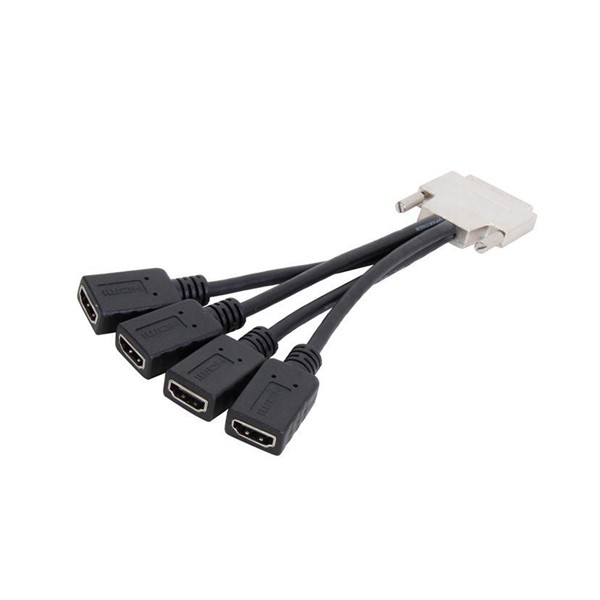
We also have the VHDCI to Quad HDMI Splitter Breakout Cable, which allows you to connect a VHDCI device to multiple HDMI displays. This cable is ideal for applications where you need to distribute video signals from a SCSI - based system.
Another popular product is our VHDCI to Quad DVI Splitter Breakout Cable. It enables you to connect a VHDCI device to multiple DVI displays, providing flexibility in your display setup.
Contact Us for Your VHDCI SCSI Cable Needs
If you're looking for high - quality VHDCI SCSI cables or have questions about cable lengths and signal degradation, we're here to help. Our team of experts can provide you with detailed information and guidance on choosing the right cable for your specific application. Whether you need a standard cable or a custom - made solution, we can meet your requirements. Contact us today to start a procurement discussion and ensure that your SCSI system operates at its best.
References
- "SCSI Interface Standards: A Technical Overview" by SCSI Trade Association
- "Cabling and Connectivity in Data Centers" by Data Center Journal
- "Electromagnetic Interference and Signal Integrity in High - Speed Digital Cables" by IEEE Transactions on Electromagnetic Compatibility