


Yo, what's up tech enthusiasts! I'm here as a supplier of 68 Pin SCSI Cables, and today we're gonna dig into the differences between a 68 Pin SCSI Cable and an Ethernet cable. It's a topic that might seem a bit technical at first, but I'll break it down in a way that's easy to understand.
Let's start with the 68 Pin SCSI Cable. SCSI, which stands for Small Computer System Interface, has been around for a while. These cables are mainly used for connecting high - speed peripheral devices to a computer. The 68 - pin variety is often found in more industrial and professional settings. For example, in data centers where you need to connect multiple hard drives, tape drives, or other storage devices in a RAID (Redundant Array of Independent Disks) configuration.
One of the key features of a 68 Pin SCSI Cable is its high data transfer capacity. It can handle large amounts of data at relatively high speeds, which is crucial when dealing with big - time storage and data processing. If you're in the business of managing large databases or running heavy - duty servers, a 68 Pin SCSI Cable is a go - to option.
We offer a range of 68 Pin SCSI Cables, like the SCSI HD 68 Pin Male to Female Extension Cable. This cable is super handy when you need to extend the connection between your devices without losing signal quality. Another great product is the Right Angle MDR 68 to 4 Ports RJ45 Cable. It's a unique cable that combines the 68 - pin SCSI interface with four RJ45 ports, giving you more flexibility in your network setup. And then there's the MD 68 Pin SCSI Cable Assembly, which is a well - built cable assembly designed for reliable performance.
Now, let's switch gears and talk about Ethernet cables. Ethernet cables are the workhorses of the networking world. You'll find them in homes, offices, schools, and pretty much anywhere there's a need for internet connectivity. They're used to connect devices like computers, routers, switches, and gaming consoles to a local area network (LAN) or the internet.
Ethernet cables come in different categories, such as Cat5e, Cat6, and Cat6a. Each category has its own data transfer speed and bandwidth capabilities. For example, Cat5e can support speeds up to 1 Gigabit per second (Gbps), while Cat6 and Cat6a can go up to 10 Gbps or even higher in some cases.
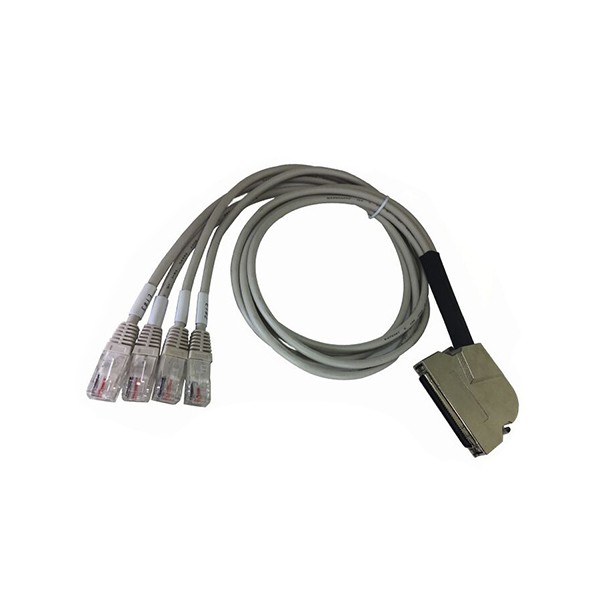

One of the biggest differences between a 68 Pin SCSI Cable and an Ethernet cable is their intended use. As I mentioned earlier, 68 Pin SCSI Cables are focused on connecting storage devices and high - speed peripherals. Ethernet cables, on the other hand, are all about networking and getting devices connected to the internet or a local network.
Another difference is in their physical design. 68 Pin SCSI Cables have a large, multi - pin connector that's specifically designed for the SCSI interface. These connectors are usually larger and more complex than the RJ45 connectors found on Ethernet cables. RJ45 connectors are smaller and more standardized, making them easier to plug and unplug.
In terms of data transfer protocols, they also vary. SCSI uses its own set of protocols to communicate between the host computer and the peripheral devices. These protocols are optimized for data storage and retrieval. Ethernet, on the other hand, uses the Ethernet protocol, which is designed for network communication, including sending and receiving data packets over a network.
When it comes to cable length, Ethernet cables can generally be run longer distances compared to 68 Pin SCSI Cables. Ethernet cables can be used up to 100 meters (about 328 feet) without significant signal degradation, depending on the category. 68 Pin SCSI Cables usually have more limited length options, and running them too long can result in signal loss and data errors.
Let's talk about the cost. Generally, 68 Pin SCSI Cables tend to be more expensive than Ethernet cables. This is because they're often used in specialized applications and are built to handle high - performance requirements. Ethernet cables, being more mass - produced and used in a wide range of consumer and business applications, are more cost - effective.
So, which one should you choose? Well, it depends on your specific needs. If you're building a data storage system or working with high - speed peripherals, a 68 Pin SCSI Cable is the way to go. But if you're setting up a home or office network, Ethernet cables are the obvious choice.
If you're in the market for 68 Pin SCSI Cables, we've got you covered. Our cables are made with high - quality materials and are rigorously tested to ensure reliable performance. Whether you need a simple extension cable or a more complex cable assembly, we have the products to meet your requirements. Don't hesitate to reach out if you have any questions or want to discuss your specific needs. We're here to help you make the right choice for your tech setup.
In conclusion, while both 68 Pin SCSI Cables and Ethernet cables are important in the world of technology, they serve very different purposes. Understanding these differences will help you make informed decisions when it comes to your networking and storage needs.
References:
- General knowledge of SCSI and Ethernet technologies from industry experience.
- Product specifications and information from relevant tech sources and manufacturers.