




What is the frequency response of a 36 Pin SCSI Cable?
As a supplier of 36 Pin SCSI cables, I often encounter inquiries about the frequency response of these cables. Understanding the frequency response is crucial for anyone looking to use SCSI cables in their systems, as it directly impacts the performance and reliability of data transmission.
Understanding Frequency Response
Frequency response refers to the way a cable responds to different frequencies of electrical signals. In the context of a 36 Pin SCSI cable, it describes how well the cable can transmit signals at various frequencies without significant loss or distortion. The frequency response of a cable is typically measured in Hertz (Hz) and is often represented as a graph showing the relationship between the input frequency and the output signal strength.
A good frequency response means that the cable can accurately transmit a wide range of frequencies, which is essential for high - speed data transfer. If the frequency response is poor, certain frequencies may be attenuated or distorted, leading to errors in data transmission, reduced signal quality, and potentially system failures.
Factors Affecting the Frequency Response of a 36 Pin SCSI Cable
Several factors can influence the frequency response of a 36 Pin SCSI cable:
- Cable Construction: The materials used in the cable, such as the conductor type, insulation material, and shielding, play a significant role. High - quality conductors with low resistance, like copper, can help maintain signal integrity at higher frequencies. Insulation materials with low dielectric constant reduce signal loss due to capacitance. Shielding, such as braided or foil shielding, protects the cable from electromagnetic interference (EMI) and radio frequency interference (RFI), which can degrade the frequency response.
- Cable Length: Longer cables generally have a more significant impact on the frequency response. As the length of the cable increases, the signal attenuation also increases, especially at higher frequencies. This is because the resistance and capacitance of the cable cause the signal to weaken over distance. Therefore, for applications requiring high - frequency signals, shorter cables are often preferred.
- Connector Quality: The connectors at the ends of the cable are also critical. Poorly made connectors can introduce additional resistance, capacitance, and inductance, which can affect the frequency response. High - quality connectors with proper mating and good electrical contact ensure a smooth transition of the signal from the cable to the device.
Measuring the Frequency Response of a 36 Pin SCSI Cable
To measure the frequency response of a 36 Pin SCSI cable, specialized test equipment is required. One common method is to use a network analyzer. A network analyzer sends a series of test signals at different frequencies through the cable and measures the output signal. The results are then plotted on a graph, showing the gain or loss of the cable at each frequency.
The frequency response curve typically shows a flat region at lower frequencies, where the cable can transmit signals with minimal loss. As the frequency increases, the curve may start to drop, indicating that the cable is less effective at transmitting higher - frequency signals. The point at which the response starts to degrade significantly is known as the cutoff frequency.
Importance of Frequency Response in SCSI Applications
In SCSI (Small Computer System Interface) applications, the frequency response is of utmost importance. SCSI interfaces are used for high - speed data transfer between devices such as hard drives, tape drives, and CD - ROM drives. A 36 Pin SCSI cable with a wide and flat frequency response can ensure that data is transmitted accurately and quickly, reducing the chances of data errors and improving overall system performance.
For example, in a server environment where multiple hard drives are connected via SCSI cables, a cable with a poor frequency response can lead to slow data access times, increased disk read/write errors, and even system crashes. On the other hand, a cable with excellent frequency response can help maintain the high - speed operation of the storage system, ensuring reliable data storage and retrieval.
Our Range of 36 Pin SCSI Cables and Their Frequency Response
At our company, we offer a variety of 36 Pin SCSI cables, each designed to meet different requirements. Our cables are carefully engineered to provide excellent frequency response, ensuring reliable data transmission.

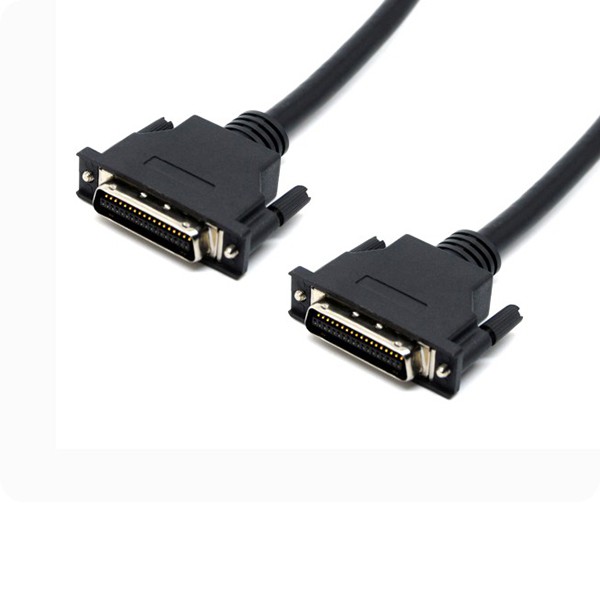
- HPCN 36 Pin Male To Male SCSI Cable This cable is constructed using high - quality materials and precision manufacturing techniques. It has a wide frequency response, making it suitable for high - speed SCSI applications. The cable is designed to minimize signal loss and interference, ensuring accurate data transfer.
- MDR 36 Position Male Cables with Screw These cables feature a unique screw - locking mechanism, which provides a secure connection. The high - quality connectors and shielding in these cables contribute to a stable frequency response, even in environments with high levels of EMI and RFI.
- VHDCI 36 Pin To VHDCI 36 Pin Cable The VHDCI (Very High - Density Cable Interconnect) design of this cable allows for high - density connections. The cable is optimized for high - frequency signal transmission, providing a flat frequency response over a wide range of frequencies.
Conclusion
In conclusion, the frequency response of a 36 Pin SCSI cable is a critical factor in determining its performance. A cable with a good frequency response can ensure reliable, high - speed data transfer, while a poor frequency response can lead to data errors and system problems. At our company, we are committed to providing high - quality 36 Pin SCSI cables with excellent frequency response.
If you are in need of 36 Pin SCSI cables for your project, we encourage you to contact us to discuss your specific requirements. Our team of experts can help you select the right cable for your application, ensuring optimal performance and reliability.
References
- "SCSI Technology Handbook" - A comprehensive guide on SCSI interfaces and related technologies, which provides in - depth information on cable performance and frequency response.
- Industry whitepapers on SCSI cable design and testing, which discuss the latest research and best practices in ensuring proper frequency response.