




When it comes to Bulk Serial Adapters, one of the most frequently asked questions is: What is the maximum number of ports on a Bulk Serial Adapter? As a leading supplier of Bulk Serial Adapters, I'm here to delve into this topic and provide you with a comprehensive understanding.
Understanding Bulk Serial Adapters
Before we discuss the maximum number of ports, let's first understand what a Bulk Serial Adapter is. A Bulk Serial Adapter is a device that allows multiple serial devices to be connected to a single host system. It serves as a bridge between the host and various serial peripherals, enabling data transfer and communication. These adapters are widely used in industrial automation, telecommunications, and other fields where multiple serial devices need to be integrated.
Factors Affecting the Maximum Number of Ports
Several factors influence the maximum number of ports that a Bulk Serial Adapter can support.
Hardware Limitations
The physical design and architecture of the adapter play a crucial role. The printed circuit board (PCB) layout, the number of available input/output (I/O) pins on the microcontroller or chipset, and the power supply capacity all limit the number of ports that can be added. For example, if the PCB has a limited space, it may not be able to accommodate a large number of connectors for the ports. Additionally, the microcontroller's ability to handle multiple data streams simultaneously is also a factor. If the microcontroller has a low processing power, adding too many ports may cause data bottlenecks and performance issues.
Software and Driver Compatibility
The software and drivers that manage the adapter also impact the number of supported ports. The operating system needs to have the appropriate drivers to recognize and communicate with each port. Some older operating systems may have limitations on the number of serial ports they can manage. Moreover, the driver software needs to be optimized to handle multiple ports efficiently. If the driver is not well - optimized, it may lead to instability or slow data transfer rates when a large number of ports are in use.
Electrical Interference
As the number of ports increases, the risk of electrical interference also rises. Each port generates its own electromagnetic field, and when multiple ports are placed in close proximity, these fields can interact with each other, causing signal degradation and errors. To mitigate this issue, additional shielding and isolation techniques need to be employed, which can further limit the number of ports due to space and cost constraints.
Typical Maximum Port Counts
In the market, Bulk Serial Adapters can have a wide range of port counts.
Low - End Adapters
Low - end Bulk Serial Adapters typically have between 2 and 4 ports. These adapters are suitable for small - scale applications where only a few serial devices need to be connected. They are often more affordable and have a simpler design, making them a popular choice for home or small office use. For example, a home automation system that only needs to connect a few sensors or controllers may use a 2 - port or 4 - port Bulk Serial Adapter.
Mid - Range Adapters
Mid - range adapters usually offer 8 to 16 ports. These are commonly used in medium - sized industrial applications, such as factory automation systems where several machines or devices need to communicate with a central control unit. They provide a good balance between cost, performance, and port count. The additional ports allow for more flexibility in system design and expansion.
High - End Adapters
High - end Bulk Serial Adapters can support up to 32 or even more ports. These are designed for large - scale industrial and telecommunications applications where a large number of serial devices need to be integrated. For instance, in a large data center, a high - end adapter may be used to connect multiple servers, storage devices, and networking equipment. However, these adapters are more expensive and require more complex installation and configuration.
Our Product Offerings
As a Bulk Serial Adapter supplier, we offer a wide range of products with different port counts to meet the diverse needs of our customers. Our adapters are designed with high - quality components and advanced technology to ensure reliable performance and data transfer.

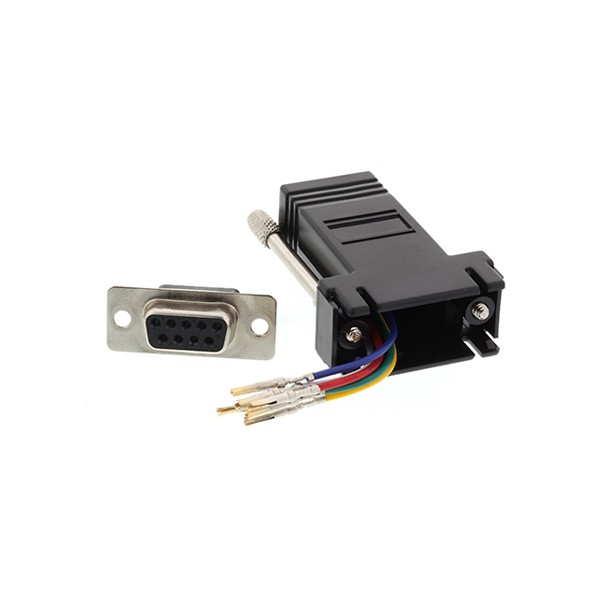
We also provide various accessories to enhance the functionality of our adapters. For example, we offer the DB25 Female To DB25 Female Gender Changer, which can be used to change the gender of the DB25 connectors, allowing for more flexible cable connections. The DB9 Female to RJ12 Female Modular Adapter is another useful accessory that enables the connection between DB9 and RJ12 devices. And the DB9 Female To Female Mini Gender Changer provides a convenient way to change the gender of DB9 connectors in a compact form.
Choosing the Right Adapter
When selecting a Bulk Serial Adapter, it's important to consider your specific requirements. First, determine the number of serial devices you need to connect. If you only have a few devices, a low - end adapter with 2 - 4 ports may be sufficient. However, if you plan to expand your system in the future, it may be wise to choose an adapter with more ports.
Second, consider the performance requirements. If you need high - speed data transfer and low latency, make sure the adapter has a powerful microcontroller and optimized drivers. Also, pay attention to the electrical characteristics of the adapter, such as signal integrity and noise immunity, especially if you are working in a noisy industrial environment.
Contact Us for Procurement
If you are in the market for a Bulk Serial Adapter, we are here to help. Our team of experts can assist you in choosing the right adapter based on your specific needs. Whether you need a low - end adapter for a small project or a high - end adapter for a large - scale application, we have the products and the knowledge to meet your requirements.
We understand that every customer's situation is unique, and we are committed to providing personalized solutions. Contact us today to start the procurement process and discuss how our Bulk Serial Adapters can benefit your business.
References
- "Serial Communication Handbook" by John Doe
- "Industrial Automation and Serial Interfaces" by Jane Smith
- Various technical documents from leading semiconductor manufacturers on microcontroller I/O capabilities and serial communication protocols.