



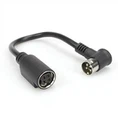
HDMI is no stranger to everyone, notebooks, players, projectors can be seen everywhere. However, although everyone often uses the HDMI interface, many people do not understand this interface. In the end, what is the history of the HDMI interface, and what is its current state of development?
First, the volume is small, the sound and picture can also be transmitted simultaneously.
The physical interface of the HDMI interface is typically very small, unlike traditional wire-filled pins, which require a lot of space during configuration. HDMI cables can be placed on products like thin and light notebooks, so the application is very wide. And it is worth mentioning that HDMI can not only transmit pictures, but also transmit sound at the same time. For products with speakers, it is not necessary to connect audio cables separately, which is very convenient. Simultaneous transmission of audio and video can be said to be the biggest feature of the HDMI interface.
Second, the version is rich, the function is getting stronger
The emergence of HDMI interface has a historical background. With the development of display technology, D-Sub interface and DVI-D interface have more stitches reserved due to compatibility reasons, so the volume is also large, for high resolution and audio. The support is not the slightest consideration, in addition to the old-fashioned interface can not support the wide color gamut, high refresh rate products, in this context, there must be a new generation of interfaces, so HDMI 1.0 appeared. The HDMI interface actually appeared in 2002, the earliest version is HDMI 1.0, and now HDMI has been upgraded to 2.0. At present, HDMI engineering wire use HDMI2.0 HD wire, and HDMI 1.4 and other standards are common in the market.

Compared to HDMI 1.4, HDMI 2.0 not only doubles the speed of processing data, but also supports the color from the original 8 bits to 12 bits. In terms of sound output performance, HDMI 2.0 can handle up to 32 channels of lossless audio. Although it sounds a bit exaggerated, it still has a lot of practical meaning in actual use. For example, the latest Dolby Atmos surround sound format has reached 64-channel cinema level, even the home version supports at least 32 channels. So, if you want a home theater to get cinema-like sound, HDMI 2.0 can be easily implemented.
Third, the emergence of optical fiber transmission distance is no longer limited
Wire is the root of data transmission, especially in the era of pure digital signals. At present, there are various types of pure silver wire, single crystal copper and oxygen-free copper on the market, and the outer cladding material is more famous. Similar materials and workmanship have caused great inconvenience to the selection and purchase of ordinary users. In particular, 4K signals are now commonplace. With the emergence of HDR and other functions, the amount of data transmission continues to increase, and people's requirements for transmission distance are also increasing. . Materials such as sterling silver wire, single crystal copper, and oxygen-free copper have been difficult to fully meet the needs of the market, so fiber HDMI cable began to appear.
At present, there are not many brands of optical fiber HDMI cables in China. This year, as the evergreen tree in the domestic audio and video equipment industry, Optical has taken the lead in launching the 100-meter optical fiber HDMI cable. It adopts the world's leading special high-resistance fiber and supports 4K@60fps. HD lossless transmission.
Optical fiber HDMI cable uses optical fiber to transmit optical signals, so there is not much demand for the use environment, universal applicability is significantly higher than traditional metal wires, signal transmission is stable under multiple complex environments, and applications with high requirements against interference and radiation are required. In terms of scenes, many high-end HDMI cables use pure silver wire, which is expensive but not very resistant to corrosion.
Fourth, technology upgrades Projection is more demanding for HDMI
Compared to other industries, the projector industry's requirements for HDMI cable are more demanding. Therefore, in the past few years, projection technology has been continuously developed. With the popularity of 4K products and HDR functions, the huge data transmission volume requires that the version of HDMI cable must be high. At the same time, high-end projectors often need to be wired inside the house, which requires the distance of the HDMI cable to be long enough and the transmission to be stable. Therefore, the projector industry is more favored for materials such as optical fiber, because it can be “once and for all”, and the new wire is refurbished in the later period of the province.
And now there are a lot of pico projectors, this product is small in size, so it can not be configured with the traditional VGA interface, so it is more popular for the small size HDMI interface. It can be said that the HDMI interface has become the most important interface form for pico projector transmission.
The history of the HDMI interface is believed to be very clear to everyone. In fact, different industries actually have different requirements for the HDMI interface. The average user may have enough HDMI interface of version 1.4, but the selection of HDMI interface in special industry can not be sloppy. It is better to consider optical fiber HDMI cable. Compared with traditional copper core wire, optical fiber HDMI cable can completely avoid long distance wiring. Unable to support issues such as 4K transfer. In short, the principle we recommend is “buy high and not buy low”. It is better to buy a higher version of the product. The high version of the HDMI interface is not only more powerful, but also a higher version of HDMI compatible with the lower version.