



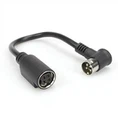
There are two main types of hard disk interface technologies used on the server, SATA and SCSI. Products using SAS hard disks are also available now, and of course high-end fiber-optic hard disks, of which the first two are the most common. Below we will briefly introduce the interface technologies such as SATA, SCSI, and SAS. For details, please see the following demo.

SATA (Serial Advanced Technology Attachment) is an abbreviation of Serial ATA. Currently, there are two standards of SATA-1 and SATA-2, and the corresponding transmission speeds are 150MB/s and 300MB/s respectively. SATA is mainly used to replace the PATA interface technology that encounters bottlenecks. From the point of view of speed, SATA is also more advanced than PATA in terms of transmission mode, and it has already far removed the PATA hard disk. Secondly, from the perspective of data transmission, SATA is more resistant to interference than PATA.
SATA-1 is now widely used, with a maximum data transfer rate of 150MBps and a signal line length of up to 1 meter. SATA generally uses a point-to-point connection, that is, one connected to the SATA interface on the motherboard, and the other directly connected to the hard disk, no other device can share this data line, and parallel ATA allows this situation (each data line can be connected 1-2 Devices, so there is no need to set up the master and slave disks like a parallel ATA hard drive.
In addition, the hot-swap function of SATA is incomparable to PATA. This feature makes it easier to set up disk arrays. Since the serial port data cable only uses a four-pin structure, it is more convenient to install the parallel port, which is more conducive to reducing the cable inside the chassis and facilitating heat dissipation.

SCSI (Small Computer System Interface) is a storage unit interface mode designed for small computer systems. It can dynamically divide multiple devices in a computer, and can appropriately allocate multiple tasks required by the system at the same time. Dynamically completed.
The SCSI specification has evolved to the sixth generation, from SCSI (8bit), Wide SCSI (8bit), Ultra Wide SCSI (8bit/16bit), Ultra Wide SCSI 2 (16bit), Ultra 160 SCSI. (16bit) to today's Ultra 320 SCSI, the speed from 1.2MB / s to the current 320MB / s has a qualitative leap. The current mainstream SCSI hard drives use the Ultra 320 SCSI interface, which provides an interface transfer speed of 320MB/s.
The SCSI hard disk also has an SCA2 interface (80-pin) that supports hot plugging technology. When used with a SCSI backplane, it is easy to hot-plug the hard disk. Currently, hot plugging is almost a must in workgroup and departmental servers.
Summary of experience:
Because SCSI has low CPU usage, high efficiency of multi-task concurrent operation, many connected devices, and long connection distance. For most server applications, it is recommended to use SCSI hard disk and adopt the latest Ultra320 SCSI controller; SATA hard disk also has Hot-swappable capability and excellent scalability on interfaces such as SCSI-SATA, FC-SATA conversion interface, and SATA port multiplier in rack servers More flexibility than SCSI. For low-end small server applications, the latest SATA drives and controllers are available.
After determining the interface and type of the hard disk, it is necessary to focus on the above-mentioned technical indicators affecting the performance of the hard disk. According to the factors such as the speed, single-disc capacity, average seek time, cache, etc., combined with the capital budget, the most suitable cost-effectiveness is selected. Hard drive solution.