




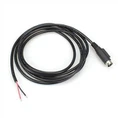
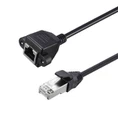
RS-232 Standard
RS-232 is a serial physical interface standard developed by EIA (Electronic Industry Association). RS is an abbreviation of English "Recommended Standard" and 232 is an identification number. RS-232 is a specification of electrical and physical characteristics that acts only on the data transmission path. It does not contain the way data is processed. Need to explain, many people often mistake RS-232, RS-422, RS-485 as the communication protocol, which is very inappropriate, in fact, they are only a mechanical and electrical interface standard for UART communication (at most The physical level in the network protocol).

The standard specifies a 25-pin DB-25 connector that specifies the signal content of each pin of the connector and also specifies the level of each signal. IBM's PCs later reduced RS-232 to a DB-9 connector, making it the standard today. The industrial control RS-232 port generally only uses RXD (2), TXD (3), GND
RS-485/RS-422 Standard
RS-232 interface enables point-to-point communication, but this method does not enable networking. So, in order to solve this problem, a new standard RS-485 was produced. The RS-485 data signal uses differential transmission, also known as balanced transmission. It uses a pair of twisted pairs, one of which is defined as A and the other is defined as B.
Normally, the positive level between the transmit drivers A and B is +2 to +6V, which is a logic state, and the negative level is -2 to 6V, which is another logic state. There is also a signal ground C, which has an "enable" end in RS-485, which is available and not available in RS-422.
The electrical performance of RS-422 is exactly the same as RS-485. The main difference is that RS-422 has 4 signal wires: two transmissions and two receptions. Since the reception and transmission of RS-422 are separate, it can be simultaneously transmitted and transmitted (full duplex), and because full duplex requires transmission and reception to have a separate channel, RS-422 is suitable for communication between two stations. Star network, ring network, can not be used for bus network; RS-485 only has 2 signal wires, so it can only work in half-duplex mode, which is often used in bus network.

Performance comparison between RS-232 and RS-485
1. Anti-interference: RS485 interface is a combination of balanced driver and differential receiver, which has good anti-noise interference. The RS232 interface uses a signal core and a signal return core to form a common transmission form. This common transmission is prone to common mode interference.
2. Transmission distance: The maximum transmission distance of the RS485 interface is 1200 m (9600 bps), which is actually up to 3000 m. The RS232 transmission distance is limited, and the maximum transmission distance is 50 meters. In fact, it can only be used at about 15 meters.
3. Communication capability: The RS-485 interface allows up to 128 transceivers to be connected on the bus. Users can easily establish a device network using a single RS-485 interface. RS-232 only allows one-to-one communication.
4. Transmission rate: The RS-232 transmission rate is low. When transmitting asynchronously, the baud rate is 20Kbps. The maximum data transfer rate of RS-485 is 10Mbps.
5. Signal Core: A half-duplex network composed of RS485 interfaces, generally only two signal lines are needed. The RS-232 port generally uses only three lines of RXD, TXD, and GND.
6. Electrical level value: The logic "1" of RS-485 is represented by the voltage difference between the two lines + (2-6) V; the logic "0" is the voltage difference between the two lines - (2-6) V means. The voltage of any signal line in RS-232-C is in a negative logic relationship. Namely: logic "1", -5 - -15V; logic "0" +5- +15V.
The serial port is a very common device interface. It is a common communication interface for instrumentation equipment. It is often used to remotely collect device data or implement remote control. The development of the serial port is also relatively simple, and it is one of the favorite interfaces of many engineers.