



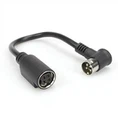
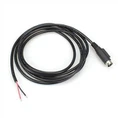
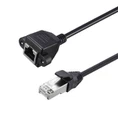
We can see that the high-end USB data cable is usually composed of: plastic casing - Braid - aluminum foil - copper core. The innermost layer is covered with a colored insulated conductor core (copper core) for transmitting data signals and current, and the plastic outer casing is used to protect the wires; while the Braid and aluminum foil layers function as a shielding function.

An important function of the USB data cable is to transmit data signals. But there may be various kinds of interference information when we use it around. If these interfering signals enter the inner conductor of the data cable, it is unlikely that the original transmitted signal will interfere with or alter the original transmission of the signal, resulting in a useful signal loss or problem.
The Braid and aluminum foil layer protect and shield the information we want to transmit. Of course, not all USB data cables have two layers of shielding, some have multiple shielding layers, and some have only one layer, or even none. Shielding is the separation of metal between two spatial regions to control the induction and radiation of electric, magnetic and electromagnetic waves from one region to another. It means that the conductor cores are surrounded by a shield to prevent them from being affected by an external electromagnetic field/interference signal, that is, the conductor core is surrounded by a shield.
The shielding layer of the USB data cable is mainly made of non-magnetic materials such as copper and aluminum, usually copper braid (aluminum-magnesium braid) or copper foil (aluminum foil, etc.), and its thickness is very thin, much smaller than the metal material used at the frequency. It should be noted that one end must be connected to the circuit signal, because the shielding effect is mainly due to the metal body itself not being on the electric field, but due to the grounding of the shielding layer, the different forms of the grounding will directly affect the shielding effect.
The production process of ordinary shielded wire is as follows:
Twisted copper-extrusion (inner core)-wound (core wire)-wrapped aluminum foil-weaving (or winding)-extrusion (outside)
In electronic connectors, letters are often used to identify the use of materials, such as:
AL stands for aluminum, such as 4C+AL, which means a 4-wire aluminum wire package.
AB stands for weaving, such as 4C+80/0.10AB, which means a 4-core braided wire with a braided gauge of 80 pieces 0.10 mm OD copper wire.
S represents the winding, such as 4C+60/0.10S, meaning 4C winding wire, the winding specification is 60 0.10mm outer diameter copper wire.