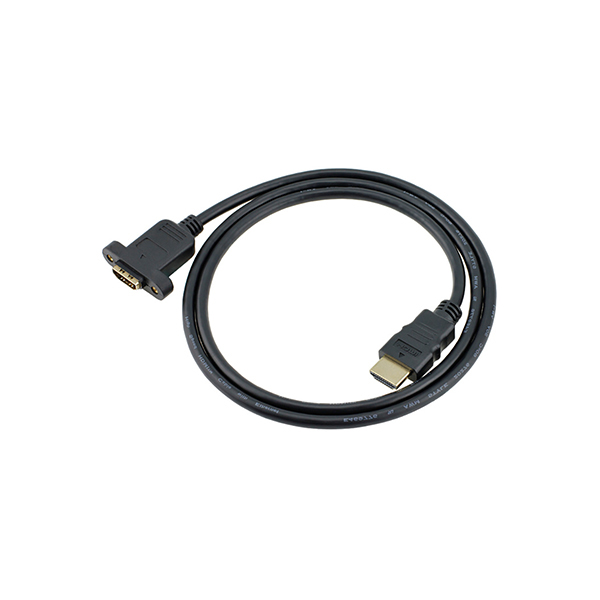

Mistake 1: The higher the grade, the better the quality
Many people think that the main difference between high-grade HDMI cable and low-grade HDMI cable is in picture quality and sound quality. The higher the quality of the HDMI cable, the higher the sound quality. In fact, the HDMI cable itself does not affect the picture quality. The picture quality is determined by the quality of the source and the performance of the display device. So where are the advantages of high-end HDMI cables? Mainly reflected in two points: First, the material is better, may use silver-plated core, or high-grade oxygen-free copper core, etc., plus multi-layer high-quality shielding layer, can ensure that the cable has more than the average wire Good anti-interference ability. Second, excellent workmanship, such as internal solder joints are more reliable (automatic welding is more uniform than manual soldering, solder joints are more uniform, solder joints are better)
Mistake 2: The higher the HDMI cable version, the better.
Whether it is HDMI 1.3 or HDMI 1.4, the differences are mainly reflected in the supported features. For example, HDMI 1.4 has added support for 3D, network support, and support for audio backhaul channels. However, this does not mean that HDMI 1.3 cable does not support 3D, nor does it mean that HDMI 1.4 cable quality will be better than HDMI 1.3 cable. In addition, although HDMI has been upgraded to version 1.4, the style of the plug has not changed. Therefore, it is difficult to distinguish the difference between the HDMI 1.4 cable and the HDMI 1.3 cable. If you really need to use the new network features in HDMI 1.4 or ARC audio backhaul, we still recommend buying well-known brands from regular channels.
Mistake 3: The thicker the HDMI cable, the better quality.
The key to determining the HDMI cable grade is the material, including the thickness and purity of the internal copper core, the quality of the joint welding process, the number of shield layers, grades, etc., but these things cannot be directly found by the naked eye. In fact, some big brands of HDMI cables will not blindly pursue a very thick body, and even the outside will not be covered with a protective net, but because of the internal use of high-quality copper core, reasonable shielding structure and superior welding process Performance and reliability are much better than those of the very large wires that look very awkward.
Mistake 4: The longer the HDMI cable, the better quality.
The HDMI cable is not only shorter and cheaper, but also has higher signal quality and higher transmission bandwidth when transmitting over short distances. In the long-distance environment, we recommend buying mid- to high-grade products of well-known brands. This is mainly based on cost-effective considerations. After all, the price of long-distance HDMI cables is generally high. If the low-grade products are not always low, the durability is not good, and the third may interfere with the quality of the signals because the parameters are not up to standard. For temporary use occasions, including some applications where the distance is short (within 2 meters), we can appropriately reduce the purchase standard, and even choose some medium and low-end products of regular brands. Because these products do not cut corners, the effect of using them in short distances is not different from that of high-grade wires.
Mistake 5: HDMI cable can be plugged in and out freely
HDMI does not support hot swapping like USB. If you plug and unplug the cable at will, it is very easy to cause damage to the HDMI terminal of the device. In serious cases, the cable will also be broken down, causing significant economic losses. In addition, although most HDMI terminals are protected by a gold-plated layer, the thickness is very limited (micron level) and the corrosion resistance is limited. Therefore, we should try to avoid direct contact with the plug when plugging and unplugging the HDMI cable. Because the sweat on the hand may cause corrosion to the metal shielding layer, resulting in poor shielding effect and increased error.