



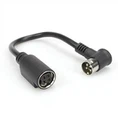
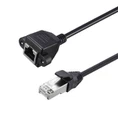
Conductors are the direct factors affecting twisted pairs. Commonly used wire conductors on the market are iron-clad aluminum, aluminum-clad copper, copper-clad silver, copper, and oxygen-free copper.

The transmission distance of iron-clad aluminum is the shortest, generally about 60-90m; the transmission distance of copper-clad aluminum is about 100m; the copper-coated silver transmission distance is slightly far, but the oxidation resistance is weak, the service life is too short, only half of the service life of other materials. The transmission distance of the whole copper wire is 80m, because it is secondary recovery copper, the impurity oxide content is too much, the resistance is high, the transmission signal is unstable; the oxygen-free copper has high purity, small resistance, strong conductivity, and the transmission distance is 100. -150m, and the transmission signal is stable. Oxygen-free copper is the core material for high-quality wire.

The signal transmission distance of the oxygen-free copper twisted pair is also affected by various factors. For example, the shielded network cable has a longer transmission distance than the unshielded network cable, and the high-quality network cable is naturally farther than the inferior network cable.
Why is the maximum transmission distance of the network cable 100m?
In theory, the maximum transmission distance of a twisted pair is 100m, but in practice it is much farther than this distance. How did this 100m limit come from?
The network signal is transported through the twisted-pair channel. During transportation, it is limited by resistance and capacitance. This causes signal attenuation and loss in long-distance transportation. When the signal attenuation and loss accumulation reaches a certain level, the signal will be inevitable. The stability and effectiveness of the product have an adverse effect.
When the network cabling distance exceeds 100m, the packet cannot be detected in time, and the packet is corrupted in the channel and can only be discarded. However, since the receiver has confirmed the reception and the fallback mechanism is not activated, the packet is transmitted. Information is lost. However, in actual operation, when the transmission rate is lower than 10 Mbps, the 100 m length limit can be relaxed. The above is explained as 100m maximum rate transmission. If the rate is reduced to 10M, the transmission distance can be extended to 150-200m, which is of course determined by the type and quality of the network cable.

When the network cabling distance exceeds 100m, the packet cannot be detected in time, and the packet is corrupted in the channel and can only be discarded. However, since the receiver has confirmed the reception and the fallback mechanism is not activated, the packet is transmitted. Information is lost. However, in actual operation, when the transmission rate is lower than 10 Mbps, the 100 m length limit can be relaxed. The above is explained as 100m maximum rate transmission. If the rate is reduced to 10M, the transmission distance can be extended to 150-200m, which is of course determined by the type and quality of the network cable.
The effect of the network cable category on the transmission distance:
The most common types of cables are Category 5 and Category 6 cables.
The difference between the Category 5 and Category 6 network cables: The Category 6 network cable improves the internal crosstalk and return loss of the cable. The return loss problem has always been one of the factors that limit the cable distance. The improvement of the return loss is greatly improved. Network cable transmission performance.