



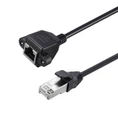
The network cable is essential for connecting the Internet. Common network cables are divided into three types: twisted pair cable, coaxial cable, and optical cable. The twisted pair cable is divided into unshielded network cable (UTP) and shielded network cable (STP). The shielded network cable is divided into single Shielded network cable and double shielded network cable. So What is the difference between an unshielded network cable and a double shielded network cable?
1. Structural Aspects
The shielding layer of the single shielded network cable has only one layer of aluminum foil paper.
The double-shielded network cable is wrapped with a layer of aluminum foil outside the twisted pair and has a metal woven mesh.
There are only 4 pairs of network cables inside the unshielded network cable.

2. Features
Double shielded network cable has the following advantages:
Shielded jacket, large diameter, large footprint
Heavy weight, difficult to install
Metal foil (aluminum foil against high frequency interference, metal mesh to prevent low frequency interference
Suitable for wiring in special places
Expensive
Unshielded network cables have the following advantages:
Unshielded jacket with small diameter saves space
Light weight, easy to bend, easy to install
Minimize crosstalk or eliminate it
Flame retardant
Independent and flexible for structured cabling
3. Practical Application
Double shielded cable is suitable for the following locations:
Industrial and mining enterprises should adopt shielded wiring system
When the transmission bandwidth is greater than 500MHz, or when supporting applications such as 2.5G/5G and 10GBASE-T
Priority should be given to shielded wiring when it comes to video sources and audio sources.
Shielded wiring can be considered in the transmission of confidential information
Shielded wiring should be used when the environmental interference source is complicated
Some subsystems in the weak electricity private network can consider shielded wiring
The horizontal subsystem of the data center can consider the shielded cabling system
Medical buildings should use shielded wiring in key parts
Unshielded cable is suitable for the following locations:
indoor
Strong places or all places with strong signal interference
The wire pairs inside the network cable are tightly wound in a counterclockwise direction. The mutual winding of the two wires is beneficial to reduce internal crosstalk and reduce external interference. In the ordinary network environment, weak electromagnetic interference to the unshielded network cable. It does not affect the core. The core inside the cable is wound by two or two. The twist of the cable refers to the length of the inner twisted pair. It is the lay length, which is used to indicate the tightness of each pair. .
Each pair of wire pairs inside the network cable is twisted in a counterclockwise direction, and the twist pitch of each pair is different. This mutual winding changes the original electronic characteristics of the cable and can resist some external electromagnetic interference. It can be used to reduce the crosstalk problem caused by its own signal.
When there is strong interference in the wiring environment, it will affect the transmission effect of the network, which will seriously interrupt the transmission signal. When the wiring environment has high-voltage wires or high-current lines of audio equipment, the network transmission signal is unstable. In this case, a double-shielded network cable is used to shield the signal of strong interference to keep the signal transmitted by the network normal.
Special reminder: Do not use shielded cable when it is not necessary, because the wiring of the shielded cable is high, not only the accessories in the system are shielded. In actual construction, it is difficult to ground the ground perfectly. If the grounding resistance of the grounding point is too large or the grounding potential is unbalanced, grounding noise will be generated, that is, a potential difference will be generated at some two points of the transmission channel, causing interference current on the metal shielding layer, so that the shielding layer itself becomes the largest interference source. The resulting performance may not even be as good as unshielded twisted pair.