



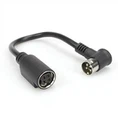
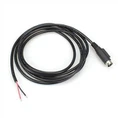
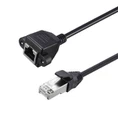
eSATA is an external interface for SATA that which achieve SATA transfer speeds, such as eSATA 1500Mbps or eSATA 3000Mbps. The eSATA 3000Mbps speed is also backward compatible with 1500Mbps, which is the same as the current desktop hard drive. The initial external SATA solution may not be able to comply with the eSATA specification, and only products that have achieved eSATA logo certification represent their compliance with the latest Serial ATA specification. Due to the faster speed of the eSATA interface, some high-end mobile hard disk enclosures already use the eSATA interface.

Speed Advantage of eSATA interface
The SATA interface is designed for use only in the system chassis. The emergence of eSATA will allow users to connect SATA hard drives outside the computer instead of being limited to the inside of the computer. Of course, you can also use USB or FireWire to achieve this function, but eSATA has a great transmission speed advantage: in the current market, USB 2.0 data transmission speed can reach 480Mb / s, IEEE 1394 data transmission speed Can reach 400Mb / s. However, eSATA has the highest data transfer speed of 3000Mb/s, which is much higher than USB2.0 and IEEE1394, and still maintains a convenient hot plug function. Users can connect or remove SATA devices at any time without shutting down. It is Very convenient.
Of course, although the eSATA2 interface can theoretically achieve a transmission rate of 3 Gbps, in practice, due to the internal transmission rate of the hard disk and the constraints of the motherboard, the actual data transmission may be between 1.5 Gbps and 3 Gbps, but still higher than IEEE 1394. USB2.0 transfer rate.
Therefore, with fast transmission speed and convenient mobility, eSATA will replace USB2.0 and IEEE 1394 as the external expansion interface in the near future.