




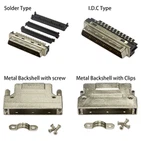
Comprehensive Analysis of 0.80mm pitch VHDCI 100-Pin Connector
i. VHDCI 100-Pin Connector: Core Hub for Industrial High-Density Connectivity
What is 0.80mm pitch SCSI VHDCI 100-Pin Connector?
VHDCI (Very High Density Connector Interface) 100-pin connector is specifically designed for high-speed data transmission and compact spaces. It is also named 0.80mm pitch HDRA 100 pin connector. 100 pin SCSI VHDCI Connector adopts a precision dual-layer layout with a 0.80mm pitch, integrates 100 signal/power pins, supports high-density signal interaction, and enables fast and stable transmission of large volumes of data within limited space.
In terms of appearance, VHDCI 100-pin connector has distinct features. 90 degree right angle VHDCI 100 pin female connector's design optimizes space utilization, and suitable for vertical board-mount scenarios. In industrial automation production lines, 0.80mm pitch SCSI VHDCI 100-pin connector is responsible for connecting various sensors, controllers, and actuators, ensuring efficient and stable operation of the production process; In data centers,100 Pin VHDCI SCSI Connector undertakes the important task of data transmission between servers, storage devices, and network equipment, guaranteeing fast data reading, writing, and processing.
II.Core Advantages: Redefining Industrial Connectivity Standards


2.1 High-Density Design: Powerful Performance in a Compact Space
Standard VHDCI 100-pin connector adopts a unique double-layer pin architecture. Within an extremely compact size, it successfully achieves the simultaneous transmission of 100 signal channels. Compared with traditional single-layer connectors, 100 position VHDCI Connector port density is significantly increased by 50%. This high-density design perfectly aligns with the current development trend of miniaturization in industrial equipment. Take the control cabinet in an industrial automation production line as an example: its internal space is limited, yet it needs to connect a large number of sensors, controllers, and actuators. Relying on its high-density feature, VHDCI 100-pin SCSI connector can complete the connection of numerous devices in a narrow space, reducing the complexity of wiring and improving the integration level of the system.
VHDCI 100P SCSI Connector precise pitch of 0.8mm is one of the key factors for achieving high density. Such a precise pitch, combined with phosphor bronze gold-plated contacts, not only ensures signal integrity but also effectively reduces the risk of crosstalk. In high-speed data transmission scenarios with speeds above 10Gbps, such as data exchange between server clusters in data centers, the VHDCI 100-pin connector can transmit data stably, ensuring the accuracy and timeliness of data and avoiding data loss or errors caused by signal interference.
2.2 Stable and Reliable, Capable of Withstanding Harsh Environments
In the industrial sector, equipment often operates in a variety of harsh working environments, and Pitch 0.80mm VHDCI 100-pin connector demonstrates exceptional adaptability. Some models feature an IP67-rated dust and water resistance design, which means the connector can function normally even in dusty factory workshops or humid outdoor environments. In construction equipment, connectors may be exposed to erosion from dust, mud, and water; the IP67 protection can effectively prevent these contaminants from entering the interior of the connector, ensuring stable connections.
It also boasts a wide operating temperature range from -40℃ to +85℃, enabling it to ensure the normal operation of equipment whether in frigid polar regions or hot desert environments. The zinc alloy housing further enhances its mechanical strength, allowing it to withstand a certain degree of vibration and impact. In industrial automation production lines, equipment generates vibrations during operation; the zinc alloy housing of VHDCI 100-pin connector can effectively resist the impact of vibrations, guaranteeing connection reliability. Additionally, its mating cycle life exceeds 500 times, far surpassing the standard of ordinary connectors. This enables it to operate stably for a long time even in application scenarios requiring frequent mating and unmating, reducing maintenance and replacement costs.

2.3 Flexible Adaptation to Simplify System Integration
The VHDCI 100-pin connector offers a wide range of options in terms of interface configurations, bringing significant convenience to system integration. It comes in various interface types, including: 90 degree VHDCI 100 pin female connector for board, Solder type VHDCI 100 pin male connector, I.D.C type 100 pin VHDCI male SCSI Connector and Dual Layer VHDCI 100 Pin Female Right Angle DIP Type Connector.
Users can make flexible selections based on their actual needs. In the motherboard connection of communication equipment, VHDCI 100 Pin Female Right Angle DIP plug-in Connector interface saves space and enables more compact wiring; while in projects requiring on-site wiring, the wire-end insulation displacement interface is convenient and efficient, eliminating the need for complex soldering operations.
It is also compatible with multiple protocols such as SCSI and PCI-e Card, and supports mixed use with low-pin-count connectors, such as 68 Pin SCSI Connector and 50 pin SCSI Connector. This feature allows it to well adapt to the upgrade needs of both new and old equipment. When enterprises upgrade their existing equipment, there is no need for large-scale equipment replacement. By simply using VHDCI 100-pin connector in combination with the original low-pin-count connectors, system expansion and upgrading can be achieved, which greatly reduces the cost of system transformation.

VHDCI 100 pin SCSI Cable Assembly

VHDCI 100 pin to HD100 pin SCSI Cable

VHDCI 100 pin to dual MDR50 pin splitter Cable
2.4 Comparative Advantage: Performance Leap Behind the Number of Pins
Within the entire VHDCI family and the broader spectrum of industrial connectors, VHDCI 100-pin connector holds a unique technical position.
Compared with more widely used 0.80mm pitch 68-pin VHDCI connector, 100-pin VHDCI connector increases the number of signal contacts by 47% while maintaining a similar physical size. This means it can enable signal transmission across more channels within the same space. Such an improvement is particularly critical in multi-axis servo control systems: the additional pins can be used to transmit control signals or feedback data for more axes, thereby reducing the number of connecting cables between devices.
When compared to Dual Stack right angle 68-pin VHDCI connectors launched by manufacturers like Molex, 100-pin version VHDCI Connector achieves a better balance between density and reliability. Although VHDCI 136-pin connectors offer higher contact density, they require tighter manufacturing tolerances, result in higher costs, and suffer from compromised vibration resistance in harsh industrial environments. Through its optimized pin pitch design, VHDCI 100-pin connector not only avoids the risk of pin bending caused by overly dense layouts but also retains a sufficient density advantage, making it a cost-effective choice for mid-range high-density connection requirements.
In competition with other interface standards, VHDCI 100-pin connector demonstrates unique strengths. Compared to consumer electronics interfaces such as USB or HDMI, it features greater mechanical strength and a wider operating temperature range. When pitted against D-sub connectors, it excels in both transmission speed and anti-interference capability. While it does not have an advantage in terms of maximum speed when compared to emerging high-speed copper cable interfaces (e.g., AEC), its mature technical ecosystem and broad device compatibility render it irreplaceable in industrial legacy systems. This characteristic makes it a "technical bridge" for connecting new and old industrial equipment.
III.Diverse Application Scenarios: A Connecting Bridge from Industry to Cutting-Edge Technology


3.1 Industrial Automation: Neural Hub for Device Interconnection
In the complex environment of smart factories, VHDCI 100-pin connector is widely used to connect key equipment such as PLCs (Programmable Logic Controllers), servo drives, and industrial cameras.

Take an automobile manufacturing plant as an example. On the automated production line, PLC is responsible for the logical control of the entire production process, servo drive precisely controls the movement of robotic arms, and the industrial camera monitors product quality and production progress in real time. Leveraging its powerful signal transmission capability, 0.80mm pitch HDRA 100-pin connector enables the synchronous transmission of multi-channel control signals and high-definition image data. It can quickly and accurately transmit the control commands sent by the PLC to the servo drive, ensuring robotic arm operates in accordance with the preset trajectory and speed. Meanwhile, the high-definition image data captured by the industrial camera can also be rapidly transmitted to the control system via the VHDCI 100-pin connector for real-time analysis and processing. Once product defects or production abnormalities are detected, the system can make timely adjustments to ensure the efficient and stable operation of the production line.
VHDCI 100 pin Connector unique double-layer structural design not only increases port density but also greatly optimizes cable layout. Space inside industrial control cabinets is usually very limited, and the wiring of traditional connectors is often intricate, which poses significant difficulties for equipment maintenance and upgrades. However, double-layer structure of 100 ways VHDCI 100-pin connector allows cables to be arranged in a neater and more orderly manner, reducing the chaos of wiring inside the cabinet and significantly improving equipment maintenance efficiency. When equipment needs to be inspected, repaired, or upgraded, technicians can more easily locate the corresponding cables and interfaces, shortening maintenance time and lowering the risk of production downtime.
3.2 Data Centers: An Efficient Link for High-Density Server Clusters
With the rapid development of emerging technologies such as cloud computing, big data, and artificial intelligence (AI), data centers are facing unprecedented pressure in data processing, placing extremely high demands on the performance of server clusters and data transmission speeds. HDRA 100 Pin SCSI Connector with its outstanding performance, has become an efficient link for high-density server clusters.
In ultra-large-scale data centers, the high-density rack deployment of blade servers is key to improving space utilization and computing efficiency. Through its 100-pin high-speed differential pairs, 100P VHDCI SCSI connector can stably transmit 10 Gigabit Ethernet and storage signals, enabling high-speed data interaction between servers. Its low-inductance design with a 0.8mm pitch effectively reduces signal delay and loss, ensuring that data can be transmitted quickly and accurately within server clusters. This is crucial for cloud computing platforms: when users perform data storage, reading, and processing in the cloud, they can enjoy near-real-time response speeds, significantly enhancing the user experience. In AI computing power platforms, massive amounts of data need to be processed and analyzed in a short period of time; the high-speed transmission performance of VHDCI 100-pin connector provides strong support for the training and inference of AI models, accelerating the development and application of AI technology.

3.3 5G and Smart Devices: A Miniaturized Connection Solution for the 5G Era
The rapid development of 5G technology has ushered in a new era of the Internet of Everything (IoE), placing higher demands on the connection performance and miniaturization of devices. SCSI VHDCI 100-pin connector demonstrates unique advantages in the field of 5G and smart devices, making it an ideal choice for miniaturized connection solutions in the 5G era.
In the AAU (Active Antenna Unit) equipment of 5G base stations, space is compact and multiple functions need to be integrated. With its 90 degree board-end mounting configuration, right angle VHDCI 100-pin female connector skillfully integrates radio frequency (RF) and baseband signals, facilitating the miniaturized design of the equipment. It can stably transmit high-speed RF signals and complex baseband data within a limited space, ensuring the efficient operation of 5G base stations. In the construction of 5G base stations, the AAU equipment adopting the VHDCI 100-pin connector has a volume reduced by more than 20% compared with traditional equipment, while its performance has been significantly improved, effectively lowering the construction cost and maintenance difficulty of base stations.

VHDCI 100-pin connector also plays an important role in smart devices such as high-end industrial cameras and drones. High-end industrial cameras need to transmit large amounts of high-definition image data in real time, while drones need to simultaneously transmit flight control signals, image data, sensor data, and more. 100 position design of the VHDCI 100-pin connector is compatible with multi-channel sensor data and power supply, achieving the integration goal of "small size and full functionality". In industrial inspection, industrial cameras quickly transmit captured high-definition images to the analysis system via VHDCI 100-pin connector, providing accurate data support for product quality inspection; in drone applications, VHDCI 100-pin connector ensures the stable transmission of various signals during flight, guaranteeing the safe flight and mission execution of drones.
IV.Selection Guide: How to choose suitable 100 pin VHDCI Connectors

Define Interface Form and Installation Method
When selecting a connector, interface form and installation method are the primary considerations. Based on the spatial layout of the equipment:
If the space is compact and vertical connection is required, a 90-degree Through Hole Mount VHDCI 100 pin female connector can be selected, such as the internal connection of blade servers in data centers.
If horizontal wiring is more convenient, 180-degree (horizontal board end) VHDCI 100 pin plug-in board type is more suitable.
The cable connection method is also crucial:
The insulation displacement connection (IDC) requires no soldering, is easy to operate, and is suitable for mass production. It is widely used in sensor wiring of industrial automation production lines. So I.D.C type VHDCI 100 pin male connector with metal cover is suitable.
Although wire-welding connection is relatively complex to operate, it has high reliability and is more preferred in customized scenarios with extremely high requirements for connection stability, such as aerospace. So solder type VHDCI 100 pin male connector with metal cover is suitable.
Taking Shenzhen Starte Technology Co., Ltd products as an example, its "Right angle 100 Pin VHDCI female connector" model is specially designed for compact board-end layouts, which can effectively save space and improve the integration of equipment.
Focus on Electrical Performance Parameters
Electrical performance parameters directly affect the transmission quality and stability of connectors. The transmission rate must be accurately matched to application requirements. For high-speed data transmission scenarios with speeds above 10Gbps, such as 5G base stations and cloud computing data centers, VHDCI 100-pin connectors with a double-layer shielding structure should be selected. This effectively reduces signal interference and loss, ensuring high-speed and stable data transmission.
The contact resistance should be ≤ 50mΩ to minimize energy loss during signal transmission; the insulation resistance should be ≥ 100MΩ @ 500V DC to ensure the safety and reliability of the connector under normal operating conditions. Meanwhile, full consideration must be given to the temperature, humidity, and protection level of the working environment. For equipment operating in harsh outdoor environments, such as the control systems of wind turbines, connectors with IP67 waterproof rating should be chosen to prevent the intrusion of moisture and dust, thus ensuring the normal operation of the equipment.
Selection of Reliable Suppliers and Certification
Selecting reliable suppliers is crucial to ensuring product quality. Priority should be given to brands certified by IATF 16949, RoHS 2.0, and other standards. IATF 16949 certification indicates that a supplier has strict standards and processes in terms of quality management systems for the automotive industry, enabling it to guarantee the consistency and reliability of products; RoHs 2.0 certification, on the other hand, ensures that products meet environmental protection requirements, restricts the use of hazardous substances, and reduces harm to the environment and human health. For example, Shenzhen Starte Technology Co., Ltd., which has 10 years of experience, has obtained multiple international certifications, and its product quality and performance have been widely recognized by the market.
During the sample testing phase, focus should be placed on verifying reliability indicators such as insertion and extraction force, and salt spray testing (for more than 48 hours). The insertion and extraction force test can evaluate the ease of inserting and extracting a connector during normal use, as well as the impact of insertion and extraction on connection stability; the salt spray test simulates the corrosion resistance of the connector in a humid, salt-containing environment. Only through strict testing can we ensure that the connector is stable and reliable in practical applications, and avoid a sharp increase in later maintenance costs caused by quality issues.
V. Future Trends: Innovative Directions for High-Density Interconnection
Automobile manufacturing
Automobile manufacturing

Automobile manufacturing
Automobile manufacturing
Automobile manufacturing
Automobile manufacturing
With the popularization of the Industrial Internet of Things (IIoT) and edge computing, VHDCI connectors are evolving toward lower power consumption, higher density, and greater intelligence. In the future, VHDCI 100-pin connectors supporting Power over Ethernet (PoE) will become a major trend. This means that while transmitting data signals, they can provide DC power to devices via Ethernet cables, further simplifying wiring and reducing system energy consumption and costs. In industrial automated production lines, the adoption of VHDCI connectors supporting PoE not only reduces the laying of power cables but also enables accurate monitoring and management of device energy consumption through a unified power supply management system, thereby improving energy utilization efficiency.
The improvement of connector density is also advancing continuously, as researchers are tackling the technical challenge of achieving a pitch of less than 0.6mm. A smaller pitch will further increase port density, meeting the future demand for high-density connections in ultra-compact spaces for devices. In the next-generation upgrade of 5G base stations, more densely packed VHDCI connectors are expected to enable more efficient signal integration, enhance the performance and miniaturization level of base stations, and lower construction and maintenance costs.
Intelligence is also a crucial direction for the future development of VHDCI 100-pin connectors. In the future, they may integrate condition monitoring chips to realize real-time monitoring of connection status and fault early warning. In data centers, with VHDCI connectors integrated with condition monitoring chips, managers can real-time grasp the working status of connectors in server clusters. Once connection abnormalities such as looseness or overheating are detected, the system can issue alerts in a timely manner and prompt maintenance measures to avoid data transmission interruptions and business losses caused by connection failures.
For enterprises and developers, it is essential to lay out device architectures compatible with the 100-pin standard in advance. This will reserve sufficient space for the future upgrade and expansion of systems, ensuring that devices can maintain good compatibility and performance amid continuous technological evolution, and reducing the costs and risks of system upgrades.